Dining Room
Oval Dining Table Ideas That Balance Length, Rounded Ends, and Circulation
Oval dining table ideas using long-axis readability, rounded ends, seating relationships, circulation, and visual weight across six dining-room settings.
An oval dining table solves a different spatial problem from either a round or rectangular table. It has a clear long axis, so it can organize a longer dining group, but its softened ends remove the hard corners that define a rectangle. That combination makes the shape useful in narrow rooms, open plans, and family dining areas where the route around the table matters as much as the tabletop itself.
The strongest oval dining table ideas keep both parts of the geometry visible. If the long axis disappears, the table can read as round. If the rounded ends disappear, it can read as rectangular. Across these six rooms, the key questions are therefore consistent: can you see the length, can you still read the curved ends, does the base support that shape, and do the seats and circulation reinforce the oval rather than obscure it?
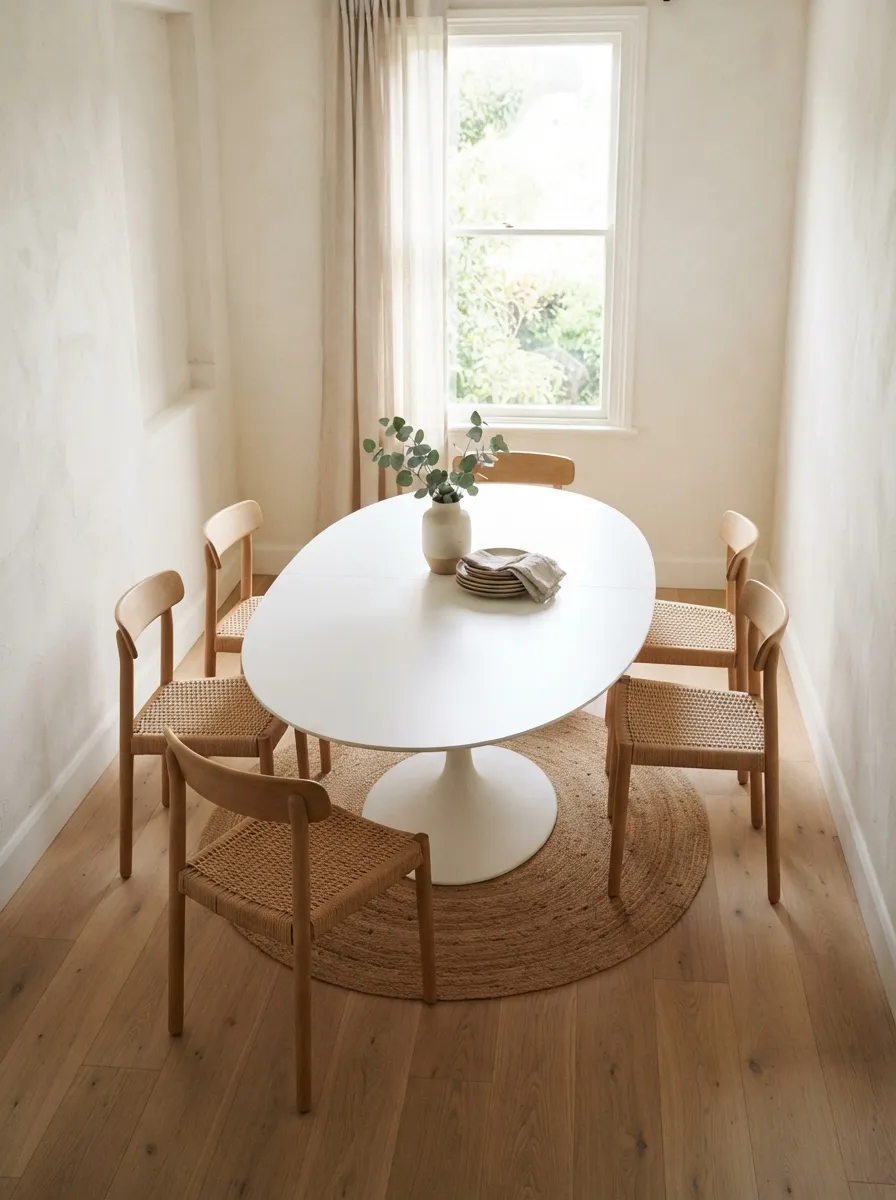
1. Use a white oval pedestal to soften circulation in a narrow room
A white oval pedestal table can make a narrow dining room feel more forgiving because the rounded ends soften the points where people pass the furniture. The table is distinctly elongated rather than circular, and exactly six freestanding dining chairs establish a clear perimeter without changing that long-axis reading.
The pedestal keeps the center beneath the tabletop visually open, while visible floor around the near rounded end makes the circulation benefit easy to understand. A small round rug creates a useful countershape below: its circle highlights the fact that the table above is longer in one direction and is therefore oval, not round.
Use the scene to compare visible shape, base, chair spacing, and approach clearance. The light wood tone of the chairs and other surface appearances do not establish exact wood species or material composition, and the image does not verify dimensions or construction.
2. Give an oval table formal weight with a warm dark wood tone
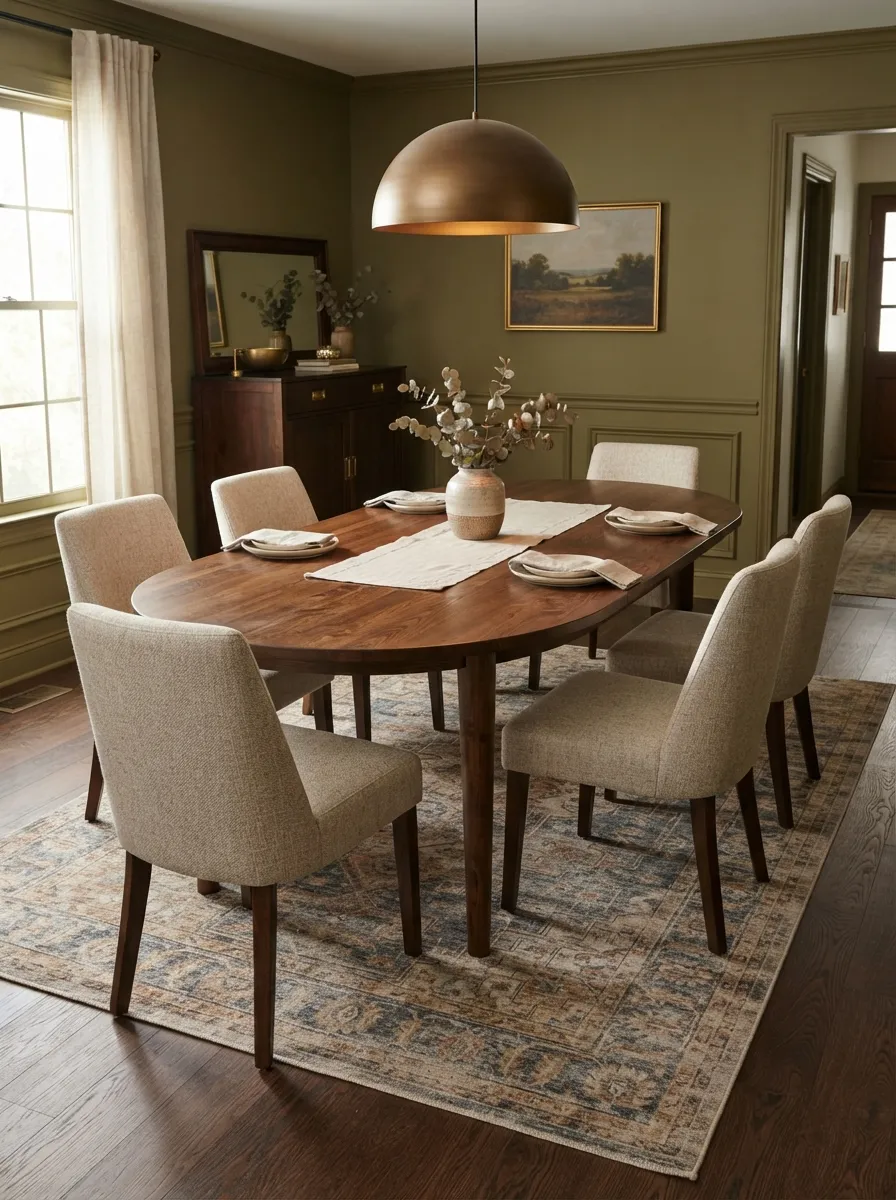
A warm dark wood-toned oval table can carry a formal dining room without becoming a flat black mass. From the low three-quarter viewpoint, the top remains visibly longer than it is wide, while both rounded ends stay legible around exactly six upholstered dining chairs.
Olive walls and a vintage-style rug deepen the room, while a bronze-toned pendant repeats the warmth above the table without becoming the main subject. The upholstered chair backs create a softer, denser cadence around the perimeter than exposed-frame chairs would, but the critical oval edge remains visible between them.
A walnut-toned appearance can describe the visible color relationship, not a verified species. Upholstery composition, performance, chair construction, table construction, finish specifications, and exact measurements all remain merchant-verification questions.
3. Let an oval table bridge an open-plan kitchen and living room
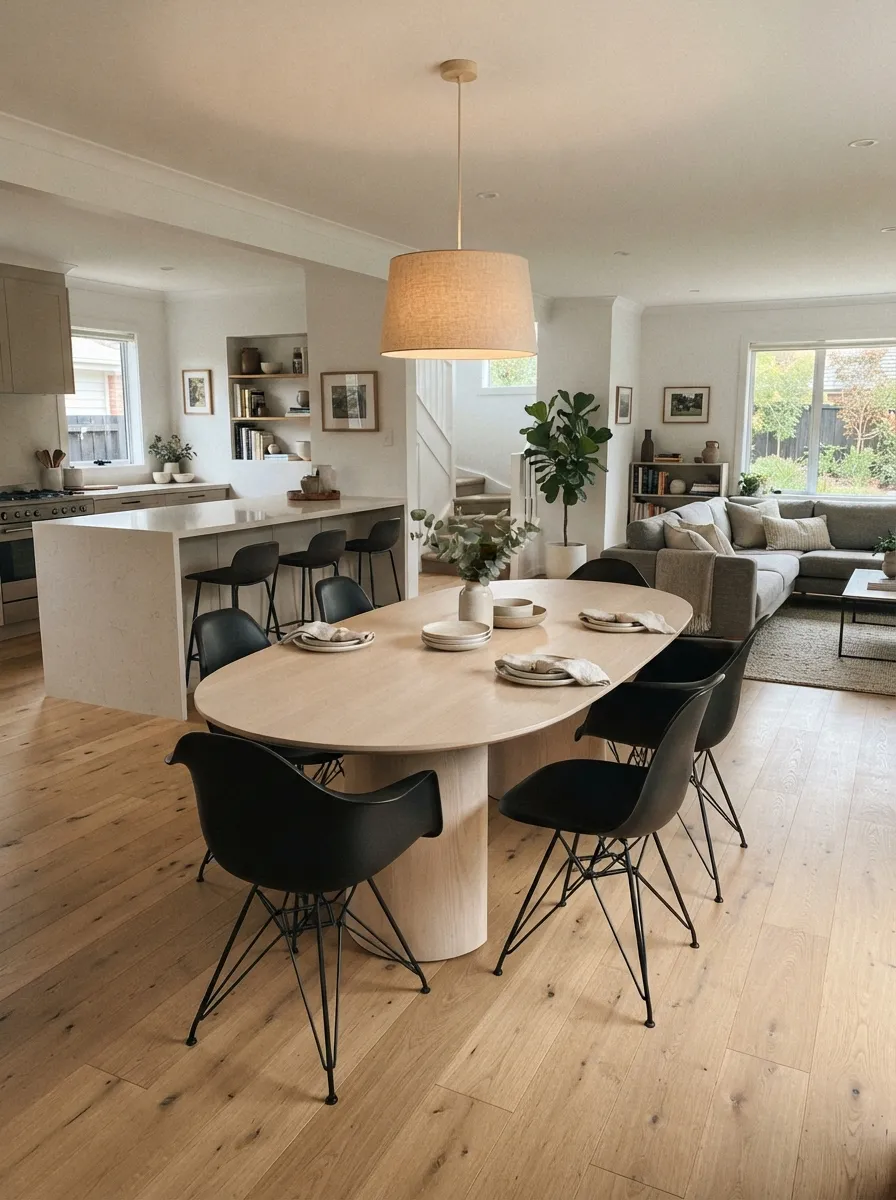
In an open plan, an oval table can bridge two neighboring zones because its long axis acknowledges the direction of the room while its curved ends avoid adding another hard rectangle between kitchen and living space. A pale oval table between the two areas creates a clear dining center without interrupting the longer sightline.
Curved black chairs define the dining perimeter but remain visually subordinate to the pale tabletop. The visible route around the group is essential: it shows that the oval is functioning within a kitchen-dining-living sequence rather than being photographed as an isolated vignette.
The table should still be read as oval, not round simply because its ends are curved and not rectangular simply because it has length. Nothing visible in the scene establishes an extension mechanism, extendable capability, exact wood species, dimensions, or construction.
4. Keep a cream stone-look oval visually grounded
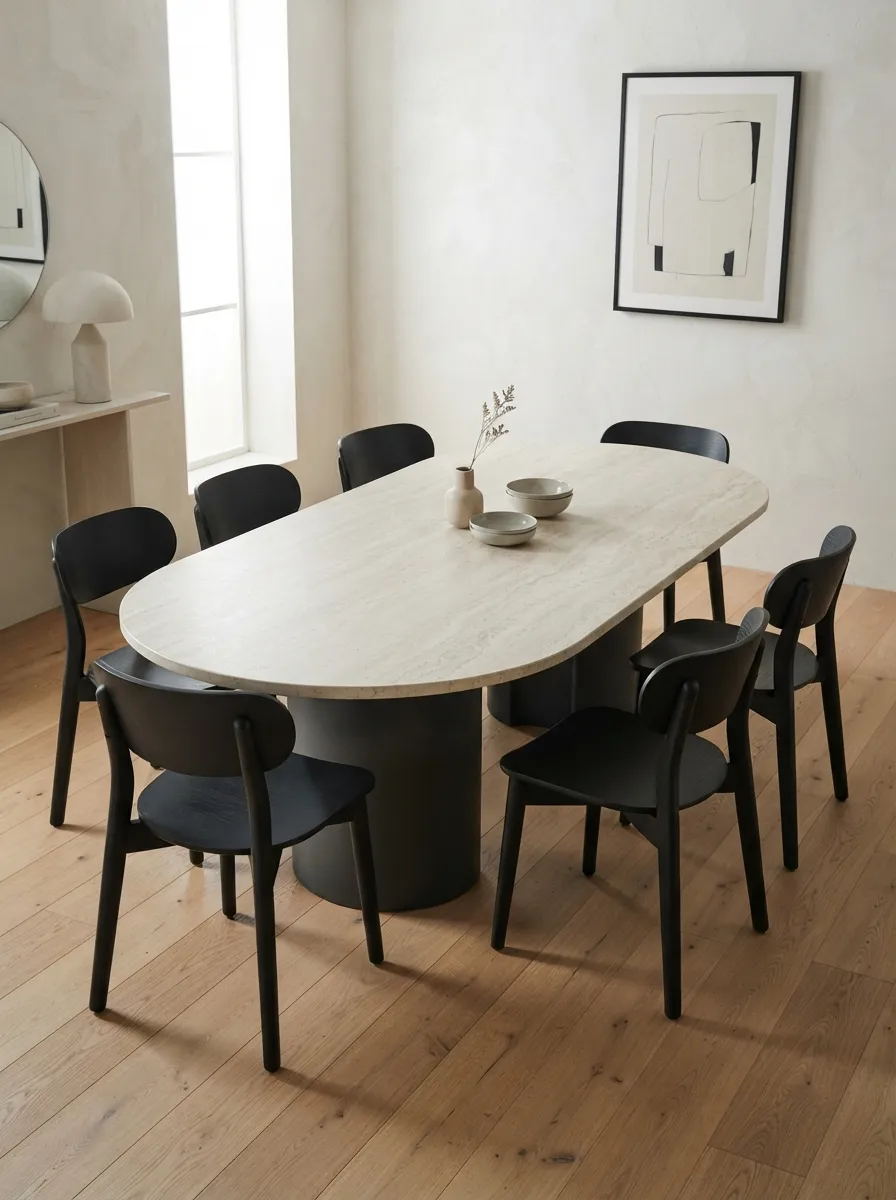
A cream stone-look oval table can create a crisp focal plane when its long axis and rounded ends remain simultaneously visible. Dark sculptural chairs provide a repeating perimeter rhythm, while pale architecture and restrained decor keep the tabletop outline from being lost in visual noise.
The base is as important as the surface. A coherent grounded support prevents the elongated top from appearing to float, while the darker chairs make the softened ends easier to distinguish from the pale room. The result is an oval with a readable center and perimeter rather than a generic pale tabletop.
Describe the surface as stone-look or marble-look appearance only. The image cannot establish actual marble, limestone, stone, exact finish, durability, table construction, chair construction, or maintenance requirements.
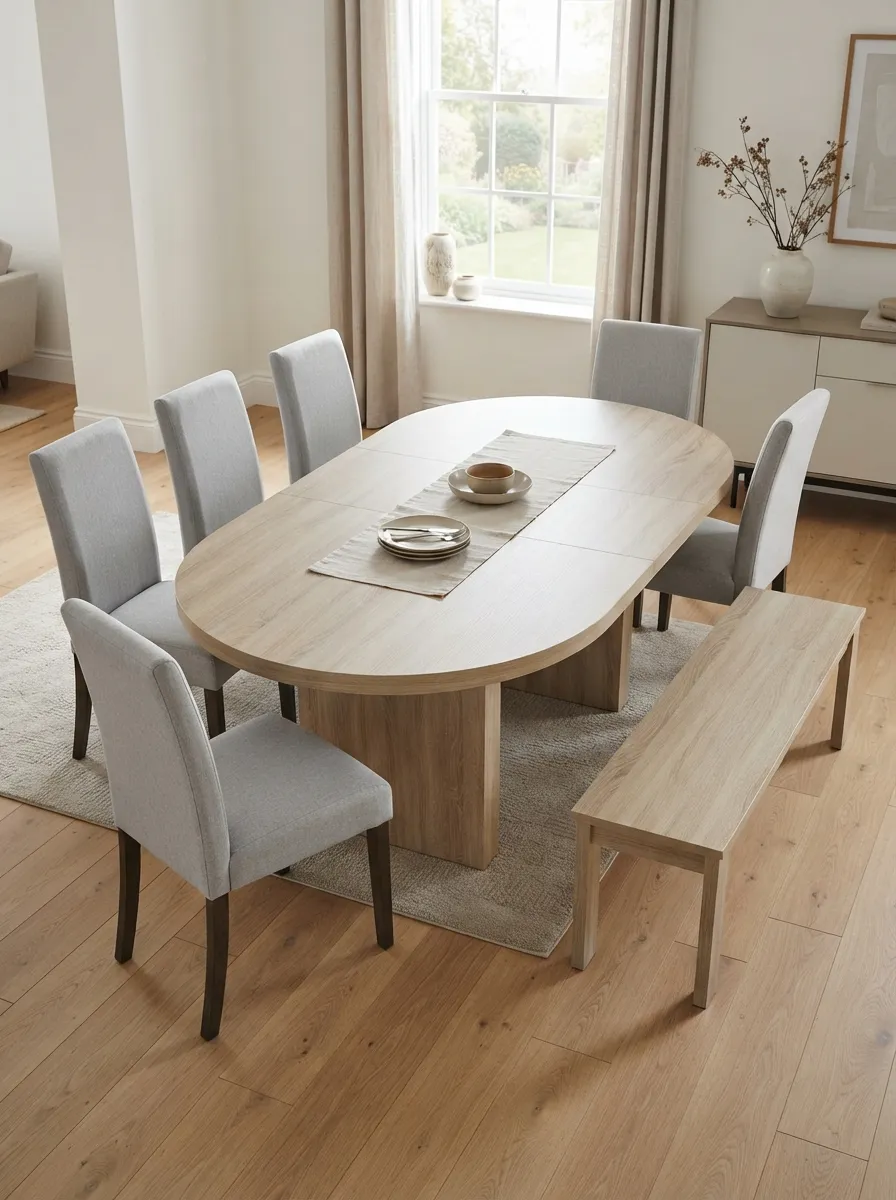
5. Put one backless bench at one rounded end
Mixed seating changes the way an oval dining group is read, so placement needs to stay precise. This arrangement uses exactly one slim backless bench at one rounded table end. There is no second bench, and there is no chair occupying that same end. Upholstered dining chairs stay along the long sides, with one side chair visibly pulled out.
The bench creates a lower visual stop at the end without turning the long side into a continuous block. Keeping it associated with the rounded end also protects the geometry: the long sides remain defined by individual chair positions, while the end treatment is visibly different. The pulled-out side chair makes the approach path feel used rather than perfectly staged.
Use the image for visible seat placement, table shape, bench relationship, and circulation. Do not infer exact dimensions, capacity beyond the seats visibly shown, upholstery composition, bench construction, table construction, load capacity, or durability.
6. Align an elongated light with the table without hiding the oval
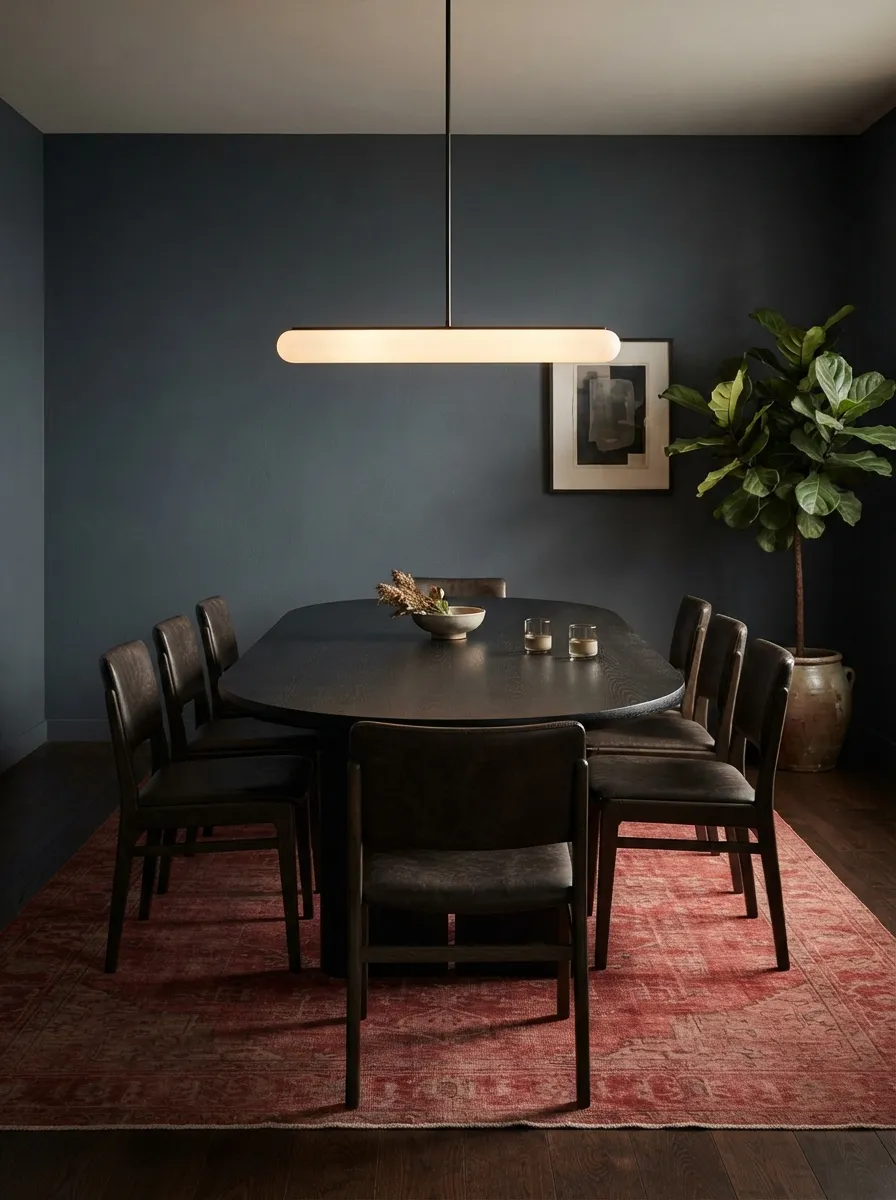
A dark oval table can remain readable in a moody dining room when contrast preserves both its length and its rounded ends. Deep blue-gray walls and a faded red rug create a darker field, while dark brown leather-like chairs stay subordinate around the perimeter.
The elongated opal-glass-look fixture aligns with the table’s long axis, reinforcing the length from above. It remains secondary because the tabletop perimeter is still visible and the light does not flatten the two softened ends. The faded red rug adds enough contrast beneath the table to help those curves remain legible from the room.
Leather-like and opal-glass-look are appearance descriptions only. The scene does not verify leather type, fixture material, lighting specifications, table species, finish, construction, dimensions, assembly, warranty, or availability.
Read the long axis and rounded ends together
An oval dining table succeeds when its length is useful without becoming visually rectangular, and when its curved ends remain clear without making the top look round. Base shape, chair cadence, end seating, fixture alignment, negative space, and the approach route all influence whether that distinction survives in the room.
Use inspiration images to compare visible proportions, long-axis readability, rounded-end readability, base and seating relationships, visual weight, and circulation. Then confirm actual materials, dimensions, construction, extension mechanisms, capacity, finish, fixture specifications, assembly, warranty, and availability directly with the merchant.
The most convincing oval dining rooms make the shape obvious before any material or styling detail has to explain it.