Dining Room
Round Dining Table Ideas That Balance Shape, Seating, and Circulation
Round dining table ideas using circular tabletop readability, base and seating relationships, circulation, and visual weight across six dining-room settings.
A round dining table gives a room a visible center. Because there is no long side to dominate the plan, the tabletop edge, base, chair positions, lighting, and walking routes all become easier to notice. That makes circular-table readability especially important: the table should look unmistakably round, its base should feel grounded, and the seating should support the same center rather than crowding it.
The strongest round dining table ideas use that geometry differently depending on the room. A pale pedestal can stay light in a breakfast nook, a dark brown table can carry a formal dining room, and a compact mixed-seating arrangement can reduce visual bulk in a tight corner. Across all six examples, the useful questions are the same: how clearly can you read the circle, how does the base relate to the seats, and does the surrounding circulation make the table feel naturally placed?
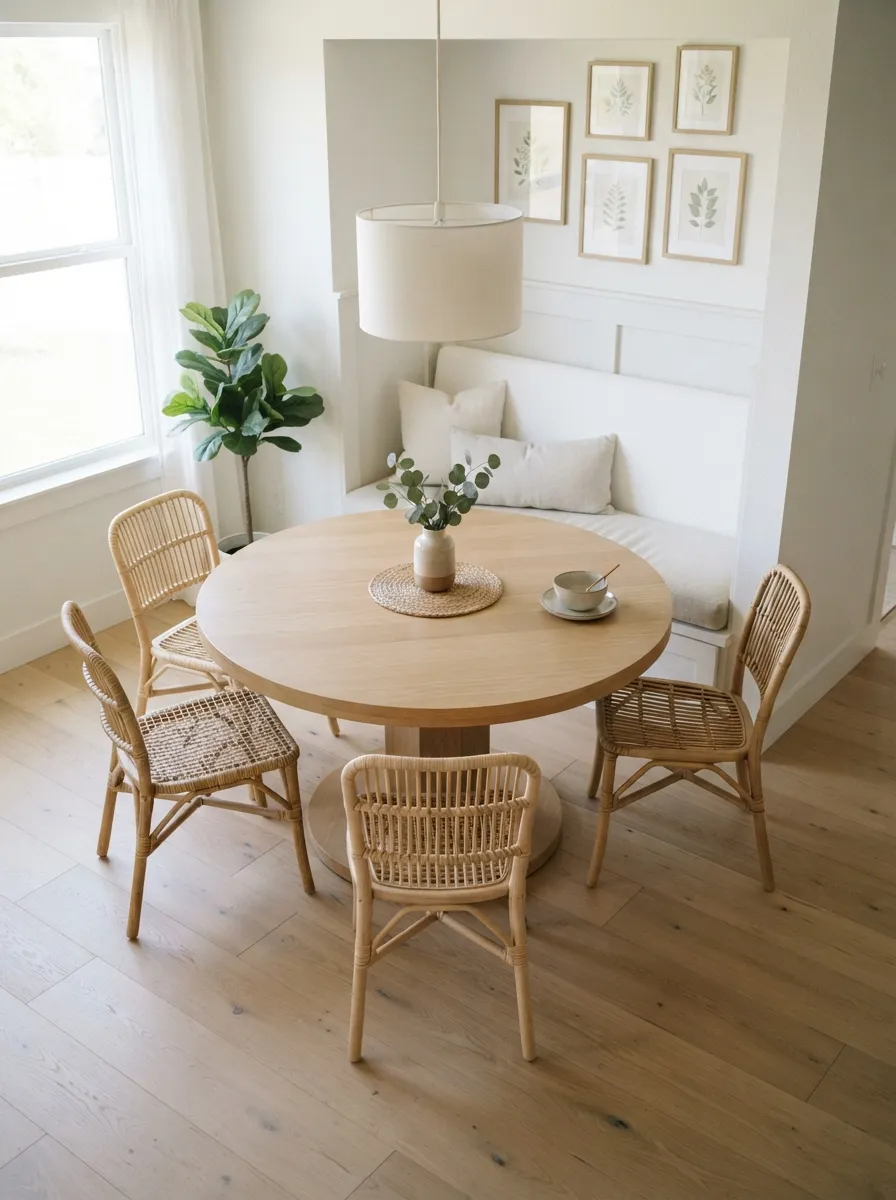
1. Keep a pale round pedestal table readable inside a breakfast nook
A pale wood-toned round pedestal table can give a breakfast nook a calm center when the seating stays clearly organized around it. Here, exactly four separate freestanding dining chairs surround the table, while one built-in banquette remains visually distinct as part of the architecture rather than being counted as another chair.
The complete circular tabletop is important because it keeps the furniture hero legible even in a layered nook. The central pedestal simplifies the area beneath the top, while the four chair positions create a readable rhythm around the perimeter. The banquette adds a separate built-in edge without replacing that freestanding-chair relationship.
Use the image to judge the visible table shape, central base, chair spacing, and overall lightness. The pale wood tone and woven-looking chair surfaces are appearance cues only; exact wood species, woven material, pendant material, dimensions, and construction still require merchant verification.
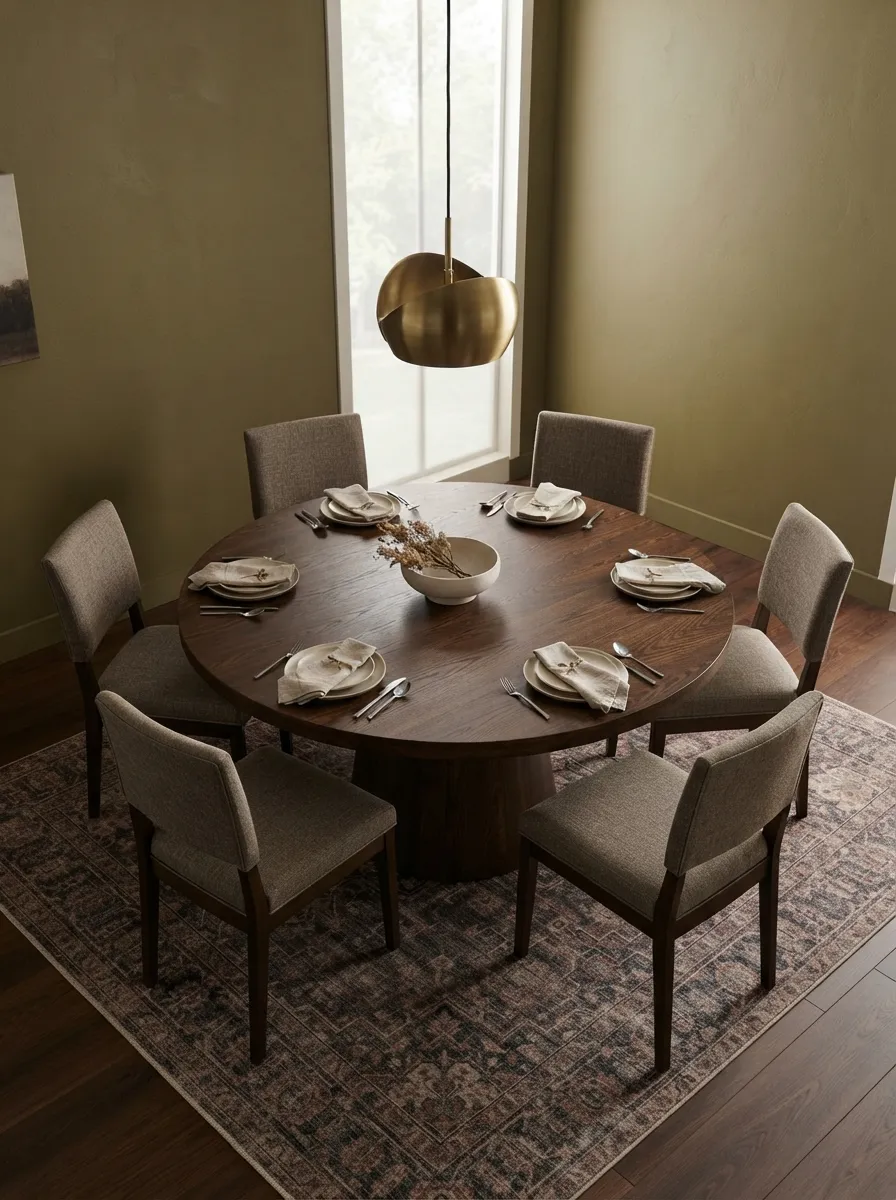
2. Let a dark brown round table anchor a formal olive dining room
A dark brown wood-toned round table can create a strong center in a formal dining room without needing to read as black. The top-oblique viewpoint exposes enough of the circumference to keep the circular shape obvious, while six upholstered chair positions form a complete perimeter around it.
Olive walls and a vintage-looking rug add visual depth, so the table needs enough reflected light to keep its brown tone visible. The brass-toned pendant reinforces the center from above, but it stays secondary to the table and seating geometry. That hierarchy keeps the room focused on the furniture rather than on the light fixture.
The scene supports visible color, scale, seating position, and visual mass. It does not establish an exact wood species, finish specification, internal construction, dimensions, or seating capacity beyond the six visible chair positions.
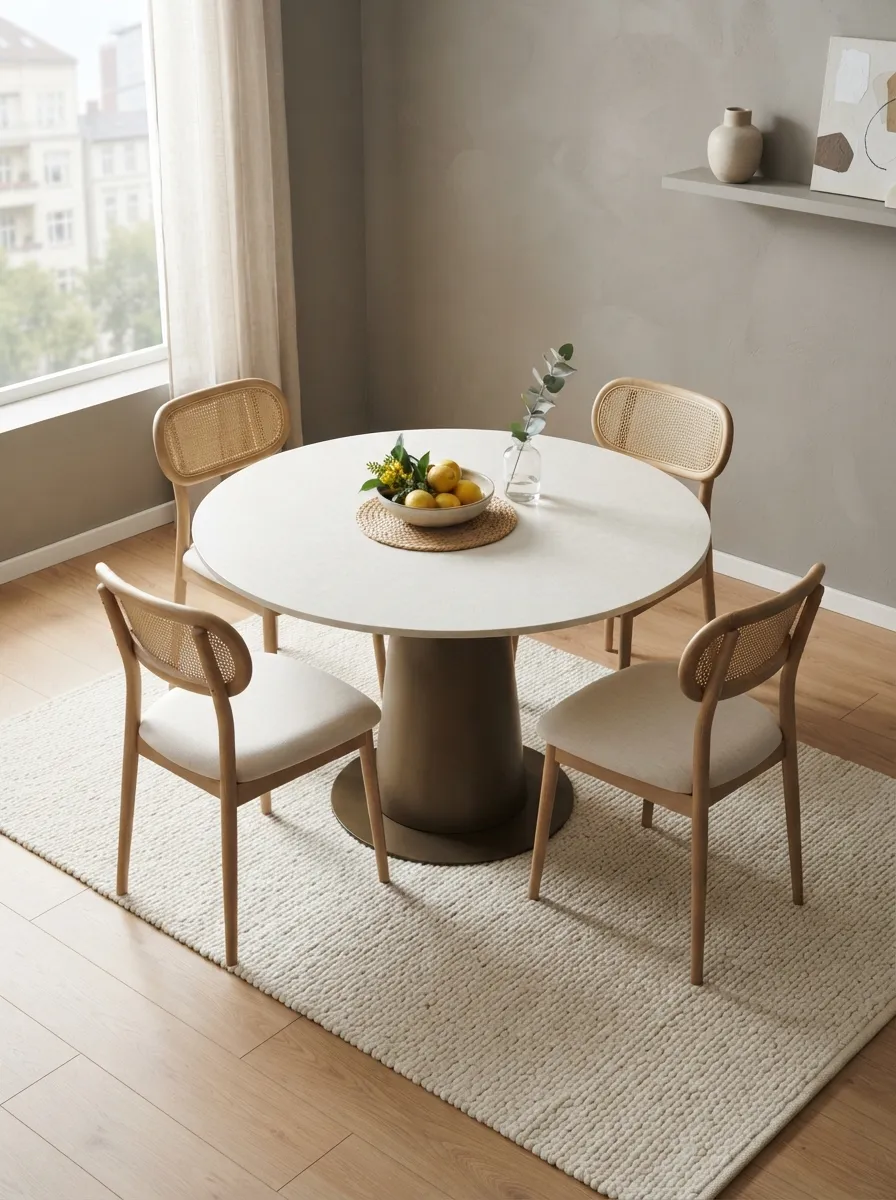
3. Use a pale stone-look round table as a crisp focal plane
A pale stone-look or marble-look round tabletop can give a city-apartment dining area a cleaner visual break than another wood surface. Warm gray walls, a cream rug, and slim light chairs prevent the pale table from feeling cold while keeping the dining group visually open.
The base matters as much as the top. A readable pedestal prevents the circular surface from appearing to float, while visible chair legs and surrounding floor keep the group from becoming one dense block. The light chairs can include woven-looking detail without requiring the material itself to be identified.
Describe the surface as stone-look or marble-look appearance only. The image cannot verify actual marble, limestone, stone, an exact wood species, cane or rattan composition, table construction, durability, or finish performance.
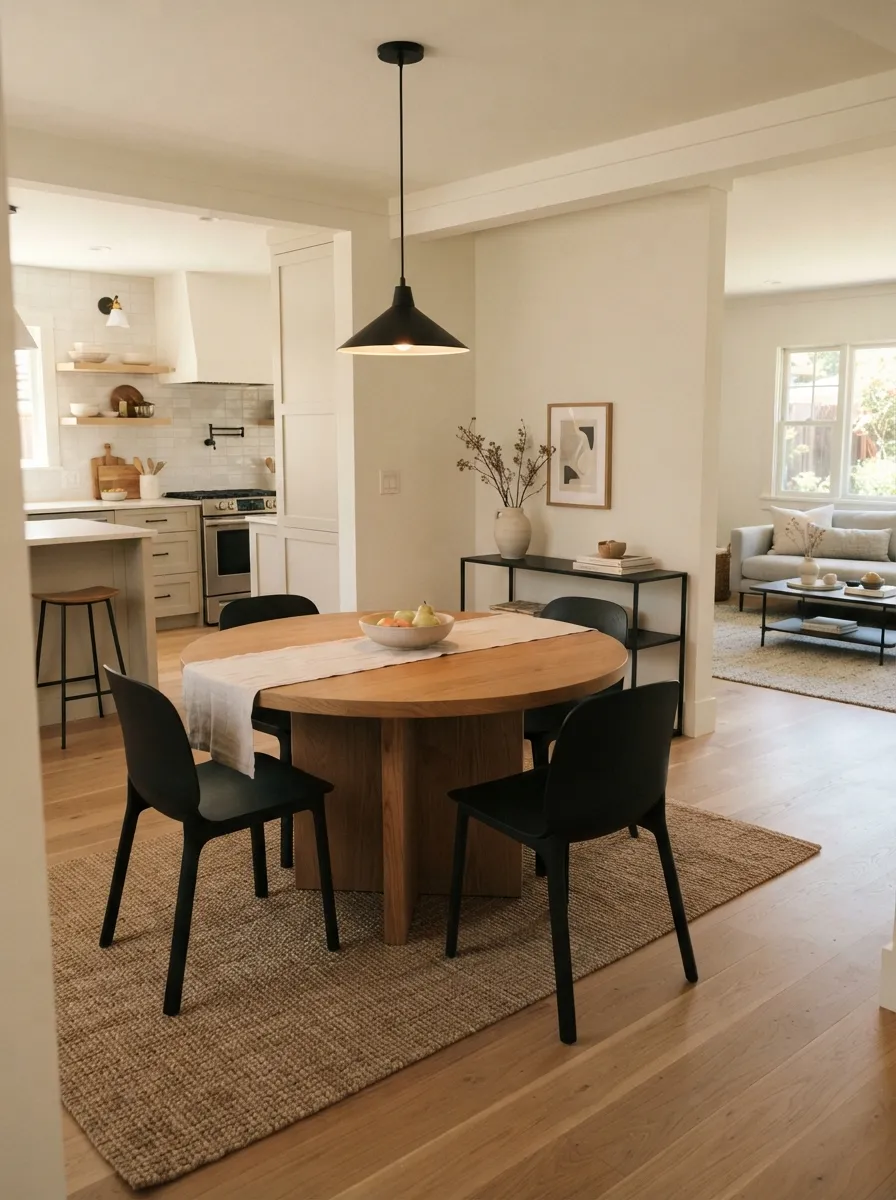
4. Keep a round dining table legible inside an open-plan transition
An open-plan dining zone has to work as part of a route, not as an isolated vignette. A medium wood-toned round table can sit between the kitchen and living area while subordinate black chairs define the dining group without becoming the dominant mass.
The lower camera position makes the circular tabletop project somewhat like an ellipse in the photograph, but that perspective effect should not change the editorial reading of the furniture itself: the table is round. Curved edge cues, the centralized base, and the chair arrangement still organize the scene around a circular center.
The visible walking route is the practical design lesson. Use it to judge whether the table belongs naturally between the neighboring zones. Do not infer an extension mechanism, extendable capability, exact wood species, exact dimensions, or construction details from the scene.
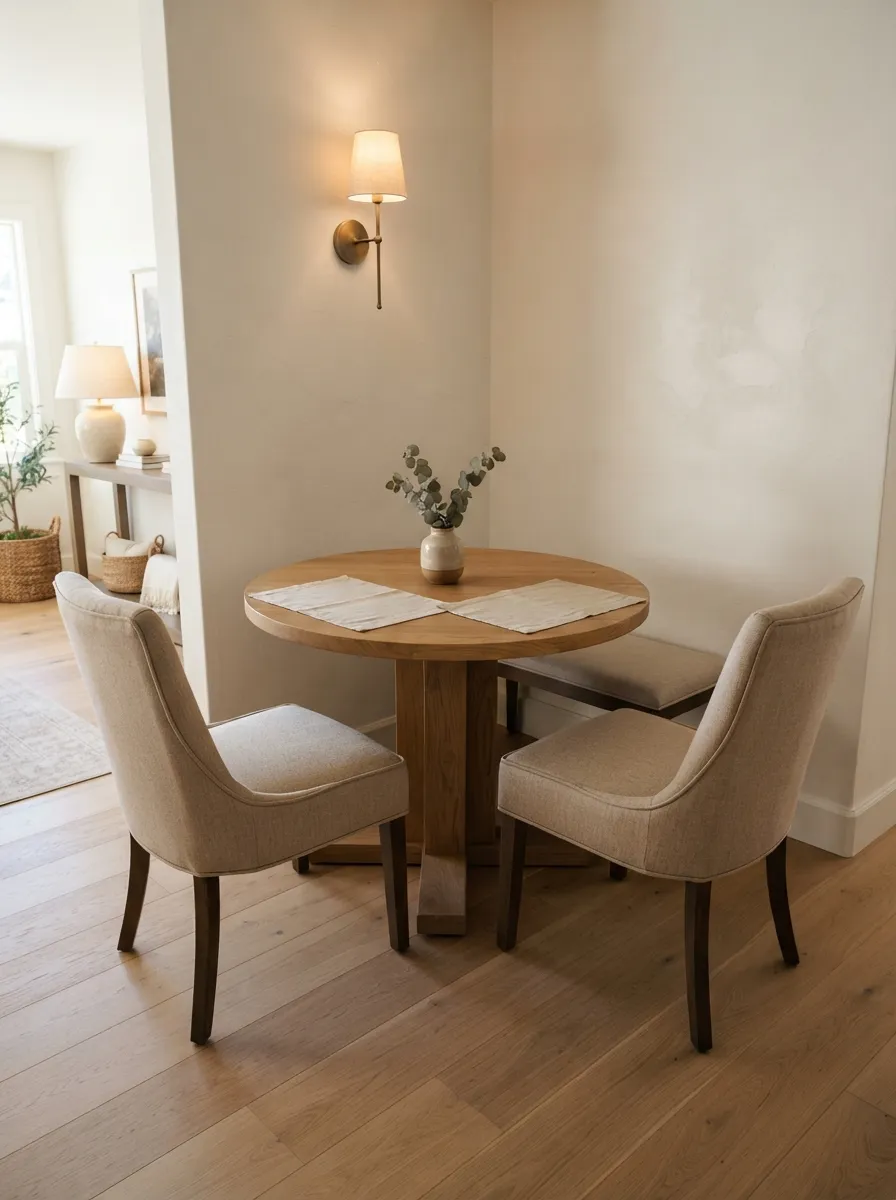
5. Reduce visual bulk with two chairs and one backless bench
Mixed seating can make a compact dining corner feel less interrupted when the composition stays exact and easy to read. This arrangement uses exactly two upholstered dining chairs plus one slim backless bench. The bench remains associated with the table and sits partly tucked beneath the round tabletop edge rather than reading as unrelated furniture.
The difference in seat height and visual mass is what makes the arrangement useful to study. The two chairs mark individual places, while the low bench removes another upright chair back from the small corner. Because the table remains the hero, the seating should explain the perimeter rather than obscure it.
A clear approach path keeps the mixed arrangement from feeling crowded. The image supports the visible seat count, bench relationship, circular tabletop, base, and circulation only; exact dimensions, upholstery composition, construction, load capacity, and seating capacity beyond what is visibly shown remain merchant-verification questions.
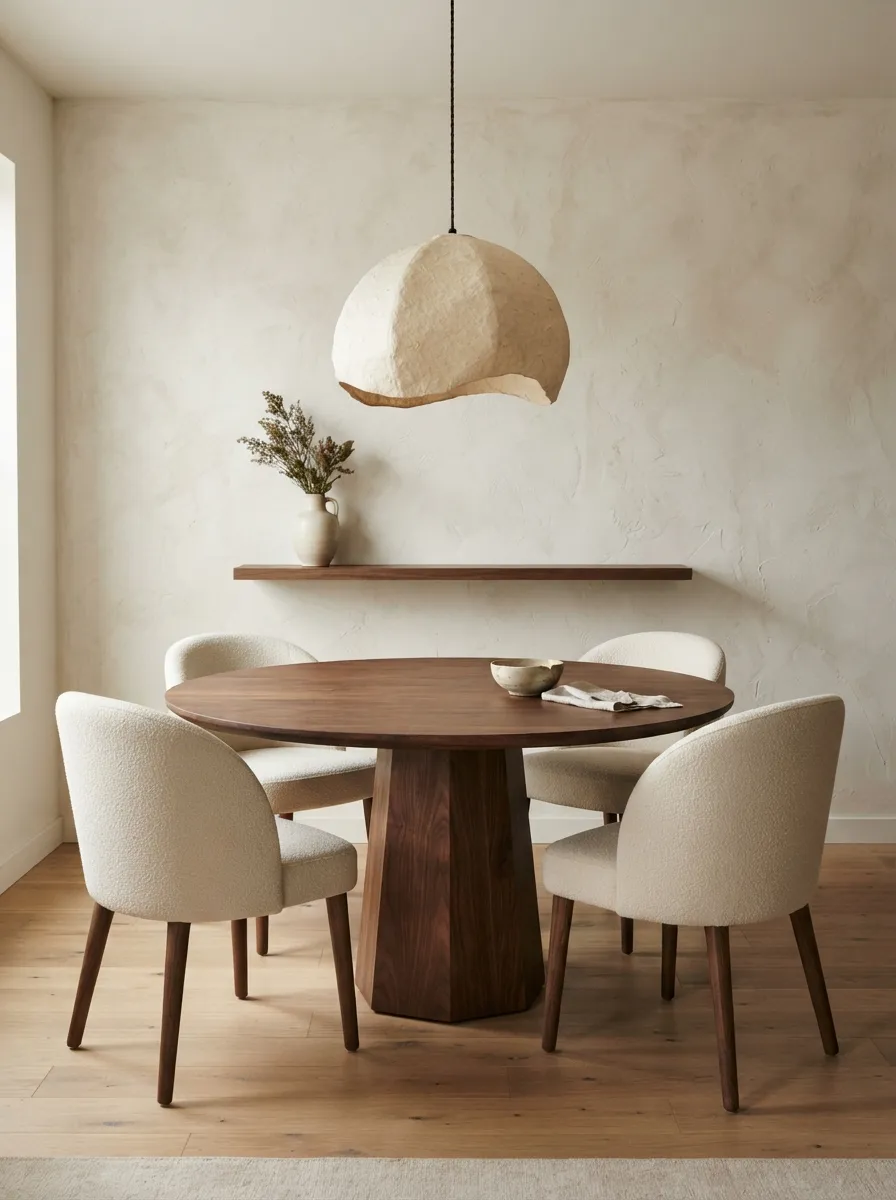
6. Center a statement pendant without letting it overtake the table
A warm dark wood-toned round table can carry a highly composed dining room when the lighting reinforces the circle without replacing it as the main furniture hero. Here, a centered statement pendant creates a strong vertical axis over the table, while sculptural cream chairs and a pale textured wall keep the surrounding field restrained.
Substantial negative space matters because both the table and pendant have visual presence. Keeping the tabletop relatively clear and the chairs light in color allows the round perimeter and grounded base to remain readable. The pendant is strong, but its job is to reinforce the table’s center rather than become the subject of the room.
Use conservative appearance language for the dark wood tone, pale textured wall, and pendant. The image cannot establish an exact walnut species, plaster composition, paper or shade material, finish specification, mounting construction, or table dimensions.
Choose the circle first, then test the base, seats, and route
Across these rooms, the most useful round-table decisions come from the same sequence. First make sure the circular tabletop is easy to read. Then check whether the base supports that center, whether the visible seats form a coherent perimeter, and whether people can approach and move past the table without the dining group becoming a barrier.
Material appearance can change the mood, but geometry controls the room first. Use inspiration images to compare visible shape, base, chair or bench relationships, visual weight, negative space, and circulation. Then verify actual materials, construction, extension mechanisms, dimensions, capacity, finish, assembly, warranty, and availability directly with the merchant.
A round dining table works best when the room makes its center obvious and gives the perimeter enough space to remain useful.