Living Room
Chaise Sectional vs. Standard Sectional: Is One Lounge Extension Worth It?
Compare chaise and standard sectionals by lounging geometry, orientation, circulation, table relationships, group seating, and product verification before buying.
Short answer: Choose a chaise sectional when habitual stretch-out lounging matters and the extended end can be oriented to suit the room; choose a standard sectional when a more even run of conventional-depth seating works better for group use. Orientation, reversibility, seat count, dimensions, connectors, and delivery fit are product-level facts that still need to be confirmed on the current listing 1 2 3.
The important difference is not simply style. A chaise changes the sectional’s visible geometry by extending one end forward, which affects how the seating zone relates to circulation, doors, windows, media placement, and tables. A standard L-shaped sectional keeps a more conventional seating depth along both runs. The three paired comparisons below use those visible relationships to support the purchase decision without treating generated imagery as proof of a specific SKU configuration.
| Decision lens | Chaise sectional | Standard sectional |
|---|---|---|
| Lounging geometry | Dedicated extended zone for stretch-out use | More conventional-depth seating across both runs |
| Room commitment | One visible direction becomes more dominant | Corner geometry is more evenly distributed |
| Table relationship | Center zone can become asymmetric | Shared central table can relate more evenly to both runs |
| Verify before buying | Orientation, fixed/reversible design, chaise depth, connectors, overall size | Overall size, corner construction, true seat layout, delivery, connectors |
1. Chaise extension vs. conventional-depth seating
The existing comparison frames the chaise as a stronger fit when one or two household members routinely want a dedicated place to stretch out, while the standard sectional better supports a more even group-seating pattern 2 3. That is a use-case recommendation from the cited guidance—not something a room image can prove.
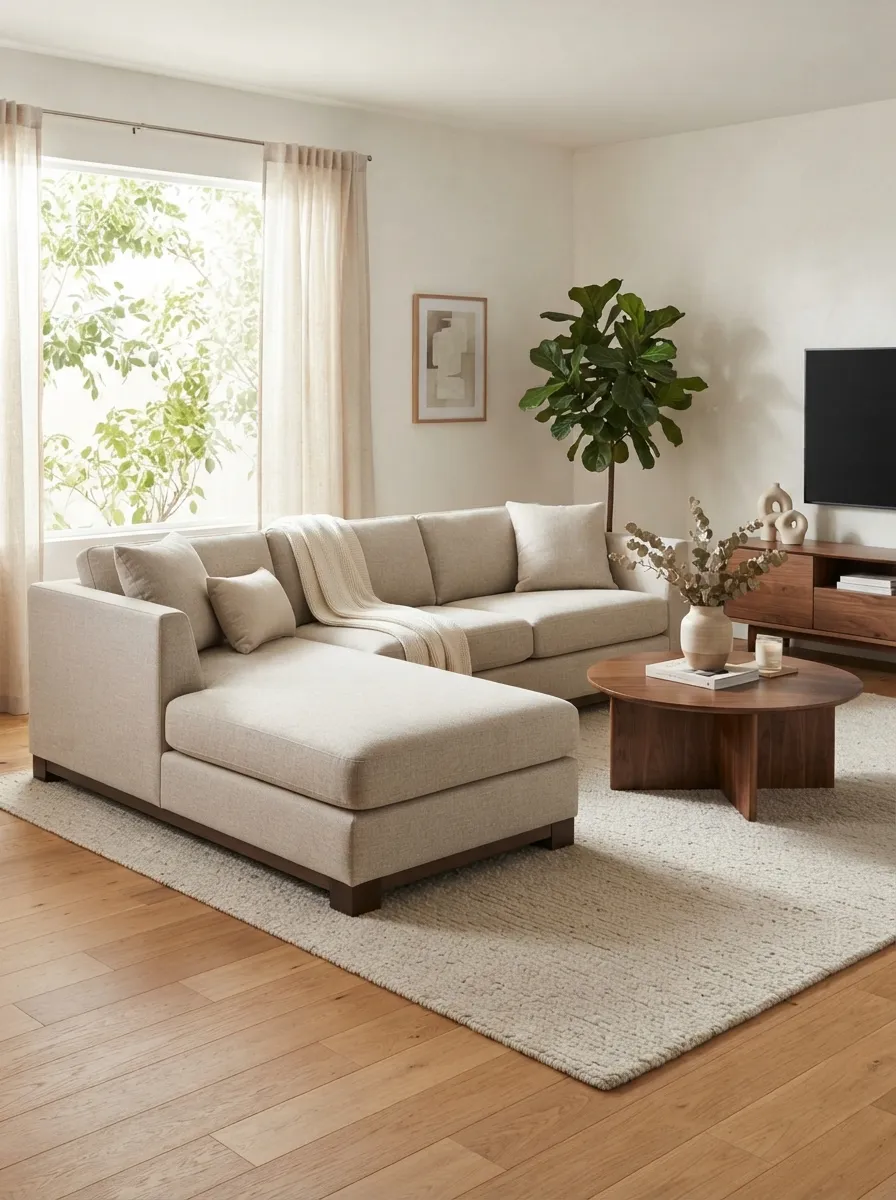
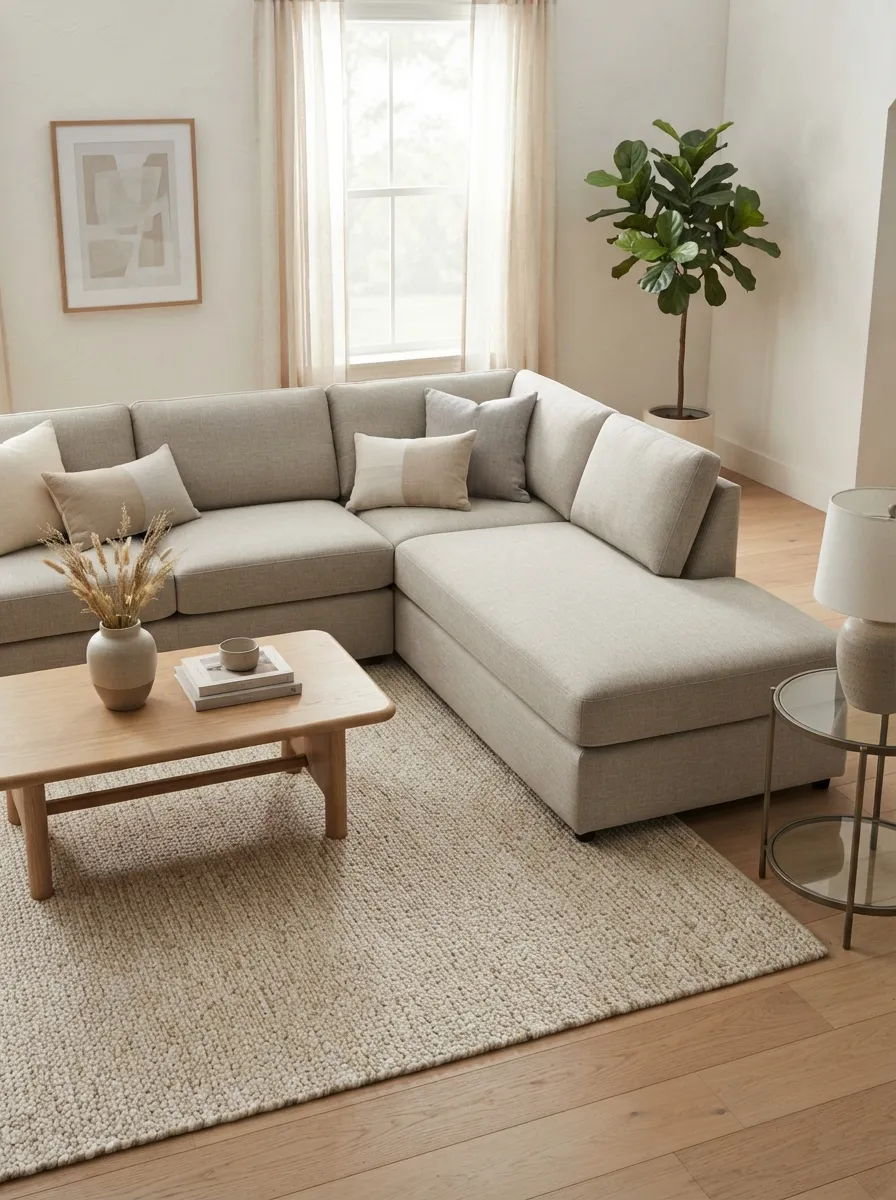
In the chaise-side visual, one light warm-neutral sectional has a clearly visible chaise-style extension projecting forward from one end. The extended platform is visually distinct from the rest of the seating, while the arms, back line, cushions, lower base, outer ends, and surrounding open floor remain readable. Bright daylight, a neutral rug, media context, and a secondary coffee table keep the focus on the asymmetry of the seating geometry.
Caption: One visible chaise-style extension creates an asymmetric lounging zone, while the rest of the sectional keeps a more conventional seating depth.
That visual supports an extended lounging form and an asymmetric silhouette only. It does not prove the actual product’s chaise designation, fixed construction, left- or right-facing SKU, reversible capability, connector system, seat count, or dimensions.
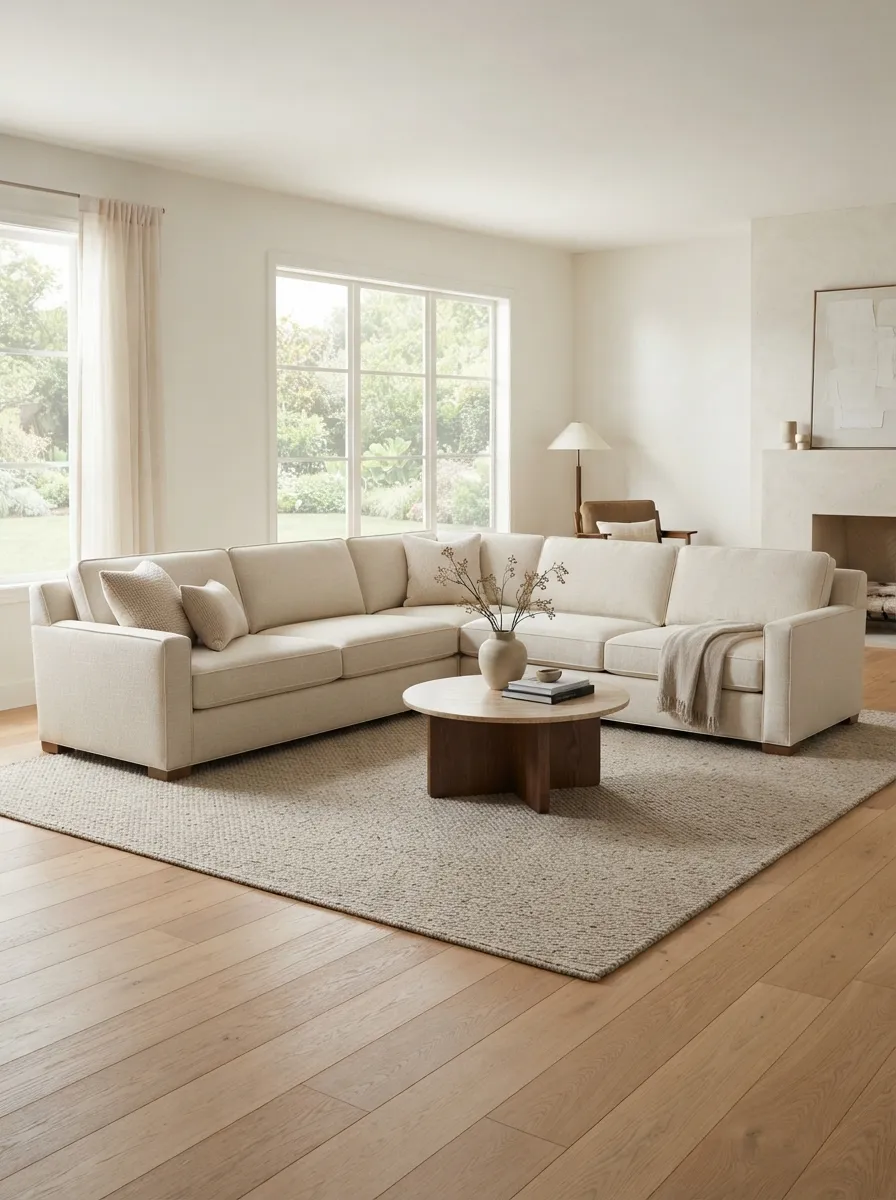
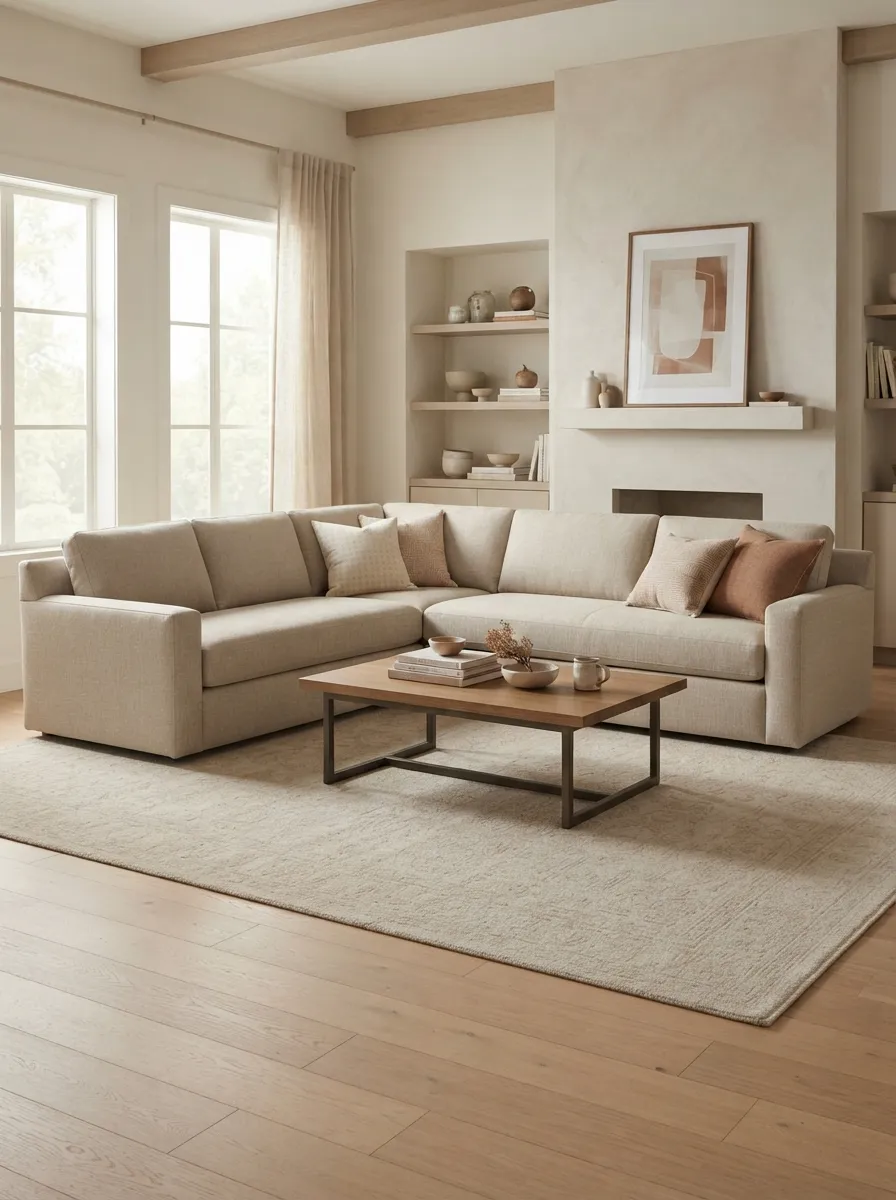
The paired standard-side visual shows one light warm-neutral L-shaped sectional with two conventional-depth seating runs meeting at a clear corner. Backrests continue along both runs, the seating depth is broadly even, and there is no elongated chaise-style platform. The room shell and styling remain broadly comparable to the first image, so the geometry difference stays easy to read.
Caption: A standard L-shaped sectional keeps conventional-depth seating along both runs, creating a more even visual rhythm around the corner.
For actual group capacity or equal seating positions, verify the current product’s seat layout, cushion widths, corner construction, and manufacturer-stated configuration rather than counting visual cushions.
2. Orientation and circulation: one dominant direction or a balanced corner?
Orientation is one of the most consequential parts of choosing a chaise sectional. The source package notes that chaise sectionals may be sold in left-facing, right-facing, reversible, or modular configurations, and that orientation should be checked against doors, windows, media placement, and the expected walking route 1. If you expect the room to change later, reversible or reconfigurable products may be useful—but that capability must be confirmed on the listing 1.
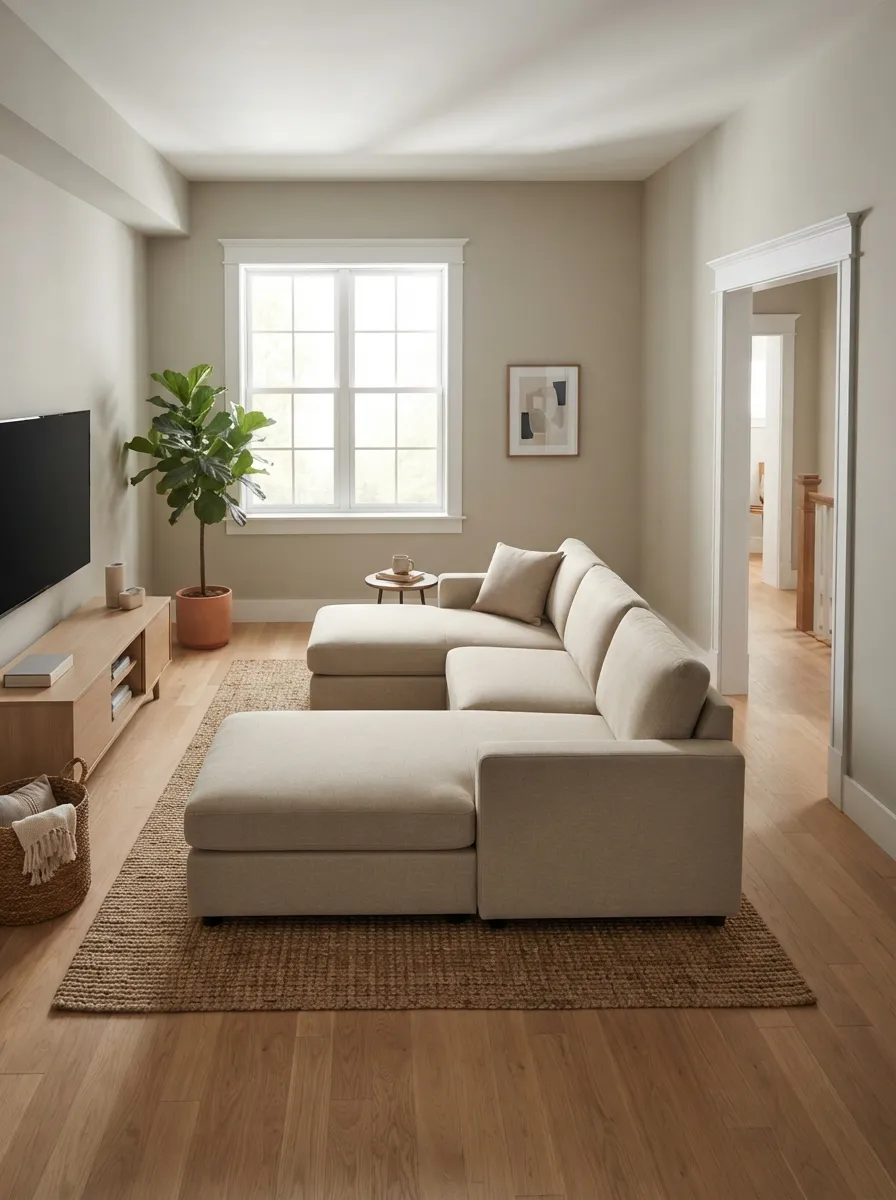
The chaise-side circulation visual makes the directional commitment easy to see. One chaise-style extension projects beyond the conventional-depth seating in a compact room, while the doorway, window, media wall, and exposed floor route remain visible. The furniture does not visually collide with the doorway, and the open floor makes the relationship between the extended end and circulation legible without measurements or arrows.
Caption: The visible chaise direction commits one side of the room more strongly, so the doorway, media wall, and open walking route become part of the layout decision.
This image does not establish left-facing or right-facing SKU terminology, exact clearances, doorway fit, or reversible construction. Those details depend on the real product and room.
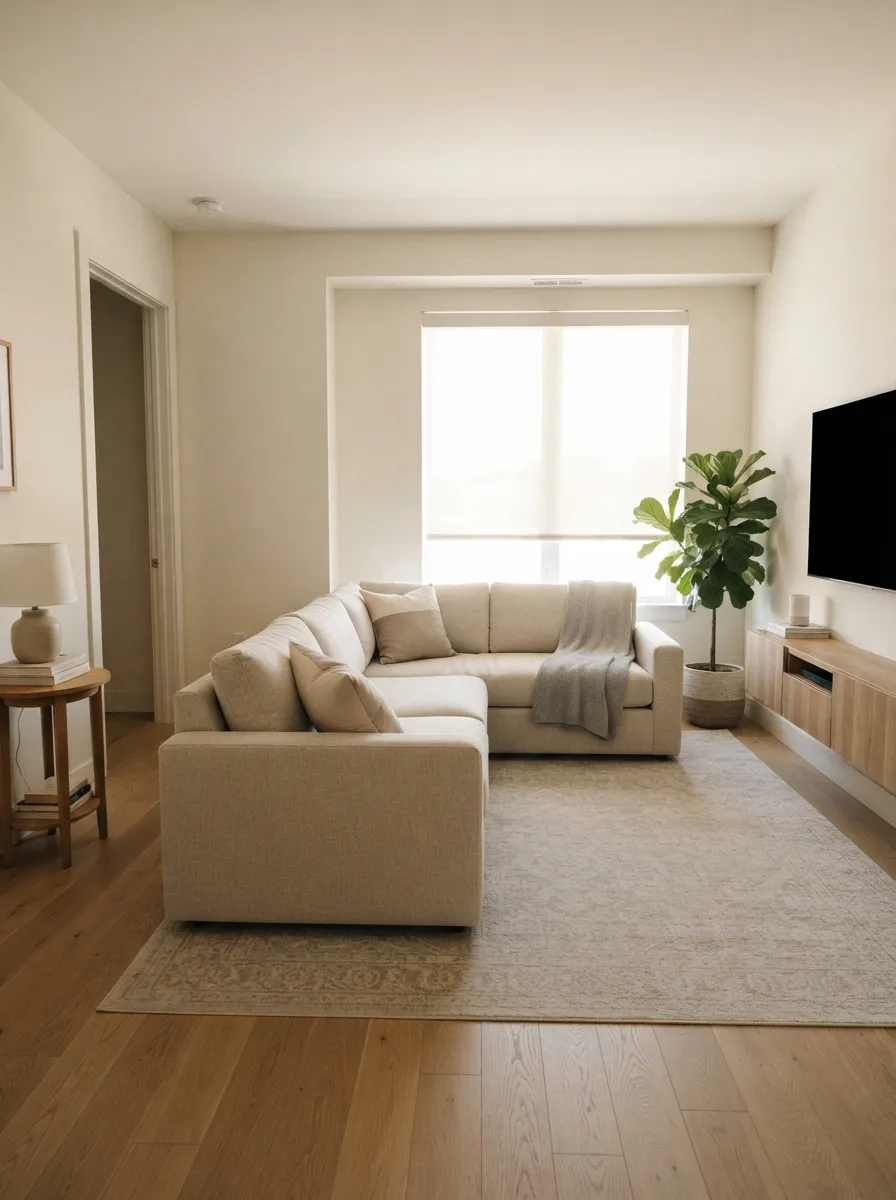
The standard-side visual uses one L-shaped sectional with conventional-depth seating along both runs. The doorway, window, media wall, and visible floor remain readable, with no chaise-style extension projecting into the circulation zone. The foreground return carries slightly more visual weight than the rear run, but the standard L-shaped geometry remains clear.
Caption: The standard L-shaped layout keeps both runs at conventional depth while preserving a readable doorway relationship and open floor around the sectional.
Use this pair to think about room-side commitment, not to infer guaranteed traffic clearances. Measure the actual room, door swings, and proposed footprint before purchase.
3. Coffee-table and center-zone relationship
A chaise also changes the center of the seating area. The original source explains that someone using an extended lounge position may have a different relationship to the central coffee table than upright sitters, which can make a side table or secondary surface useful 1. That is a planning principle, not an ergonomic reach claim that can be proven from a picture.
In the chaise-side visual, one central coffee table sits mainly in front of the conventional-depth seating, while one smaller separate side table sits near the chaise-style end. The two tables remain visibly separate, the extended platform stays unobstructed, and the sectional geometry remains the primary subject. The coffee table sits fairly close to the lower-left frame edge, but the intended center-zone relationship remains readable.
Caption: The chaise-style extension makes the center zone asymmetric: one coffee table serves the standard-depth seating while a smaller separate side table sits near the extended end.
Do not read the image as proof of ideal reach, ergonomic distance, or required table placement. Table dimensions and clearances still need to be tested in the real room.
The standard-side comparison shows one conventional L-shaped sectional and exactly one central coffee table positioned within the main seating zone. Both seating runs visually relate to the same shared table, creating a more centered furniture relationship than the chaise-side composition.
Caption: A standard L-shaped sectional creates a more centered shared-table relationship, with one coffee table visually connected to both seating runs.
Again, this supports visible furniture relationships only. It does not prove equal reach from every seat, sightline parity, or exact clearance.
Lounging habits, group use, and the dominant-seat effect
The source package treats daily habits as the deciding factor. A chaise can create an obvious lounge position for households that repeatedly stretch out while watching television or relaxing 2. A standard sectional can make the seating zone feel more evenly distributed when several people are usually sitting upright together.
The useful question is not whether one format is universally better. It is whether the room has a recurring behavior that justifies dedicating one end to an extended lounging zone. If the chaise would be used every day, its asymmetry may be worthwhile. If the room is mostly for conversation, game nights, or several upright sitters, a conventional-depth L-shaped layout may feel easier to share.
Flexibility, reversible chaises, and movable ottomans
The source material also identifies reversible chaises, modular configurations, and movable ottomans as ways to reduce long-term layout commitment 1 3. Those options can matter if you expect to move homes, rotate the room, or change which side of the sectional faces the main route.
Treat those as product archetypes rather than visible facts about the six images. Before buying, confirm whether the chaise is fixed or reversible, whether individual sections can be separated, how connectors work, and whether an ottoman is freestanding or designed to align with the sectional. Verify dimensions, weight, connector hardware, assembly, and anti-slip or locking details where relevant.
Decision logic you can use now
Choose a chaise sectional when habitual lounging is a real part of daily life, the visible extended end can be placed on the correct room side, and the resulting circulation and table layout still work. Choose a standard sectional when you want a more conventional-depth seating pattern across both runs and prefer a centered shared-table relationship.
If future reconfiguration is important, consider a merchant-verified reversible chaise, modular sectional, or sectional-plus-ottoman arrangement. Do not assume those capabilities from product photos alone 1 3.
Before purchase, measure the room and access path, then verify overall width and depth, chaise orientation, whether the chaise is fixed or reversible, seat layout, connector system, delivery method, assembly requirements, materials, warranty, and current availability with the merchant or manufacturer. Images can clarify geometry; the listing establishes the product.