Living Room
Coffee Table Living Room Ideas for Shape, Scale, and Visual Weight
Coffee table living room ideas that compare round, stone-look, glass, dark rectangular, nesting, and sculptural pedestal tables by shape, room openness, circulation, and visual weight.
A coffee table can change how a living room feels even when the sofa stays exactly where it is. Shape affects how easily the eye moves through the seating area, transparency changes how much floor remains visually present, darker finishes can anchor a pale or softly lit room, and nesting tables let the center of the room expand or contract without adding unrelated furniture.
Before choosing a style, compare the table with the seating around it. Retailer guidance is not perfectly uniform: Crate & Barrel recommends roughly 14 inches between a sofa and coffee table, while Pottery Barn suggests about 18 inches. Treat that 14–18 inch span as a practical starting band rather than a universal rule, then test reach, circulation, and the actual dimensions of your room and furniture 1 2. Both also emphasize proportion between sofa and table rather than choosing a coffee table in isolation 1 2.
The six coffee table living room ideas below focus on different visible decisions: soft round geometry, pale visual mass, transparent openness, dark rectangular contrast, flexible nesting surfaces, and a sculptural focal shape.
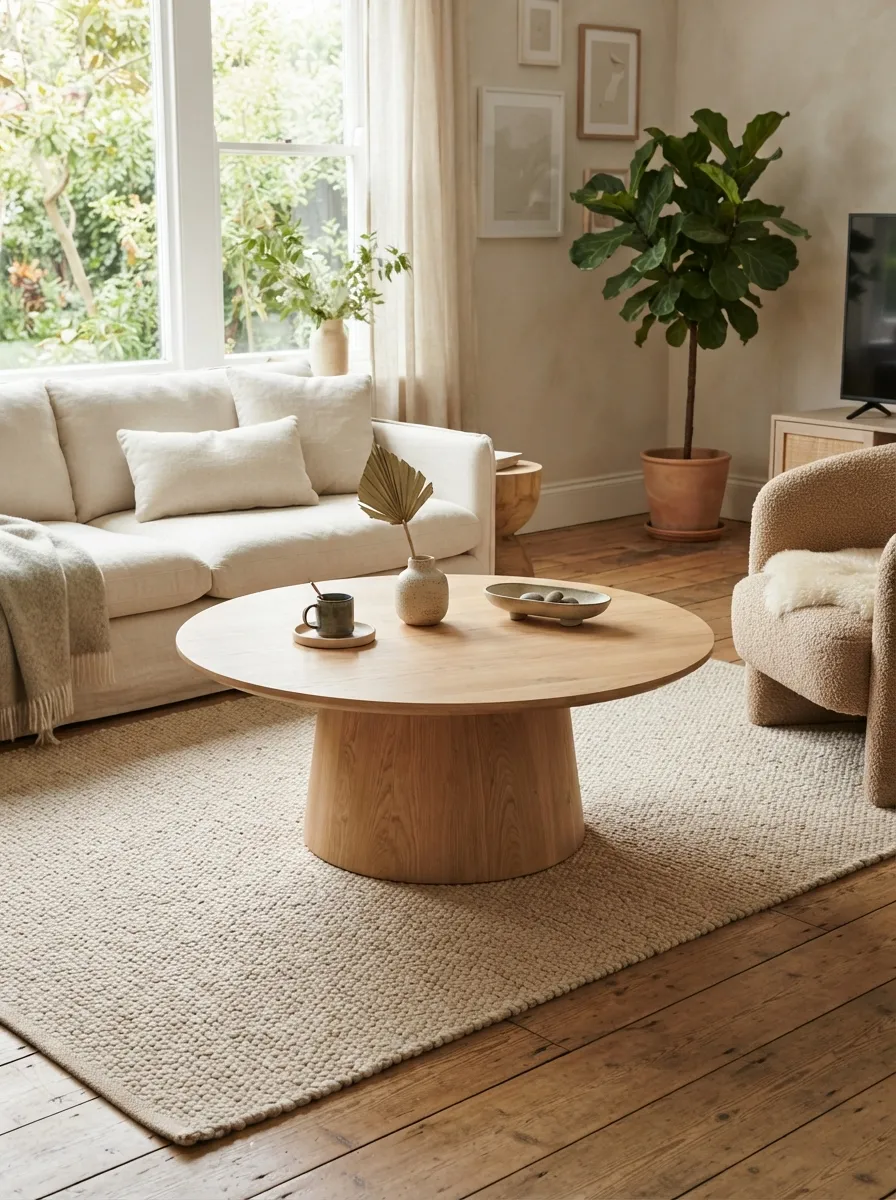
1. Use a round light wood-toned table to soften the seating geometry
A round coffee table can make a seating group feel less rigid because it removes the hard corners that often repeat across sofas, rugs, and casegoods. Crate & Barrel describes round tables as a way to soften room lines and make movement around the table easier, while West Elm similarly recommends rounded shapes when circulation is tight 1 3.
Here, exactly one round light wood-toned coffee table sits at the center of a bright organic-modern room. The complete circular tabletop and edge profile are visible, and the pedestal-style base keeps the table legible as one compact form. Seating, plants, rug, and decor stay secondary, while open floor around the table keeps circulation visually understandable.
This scene supports shape, apparent tone, room relationship, and openness only. It does not establish actual wood species, solid-wood or veneer construction, finish chemistry, dimensions, joinery, load capacity, or durability.
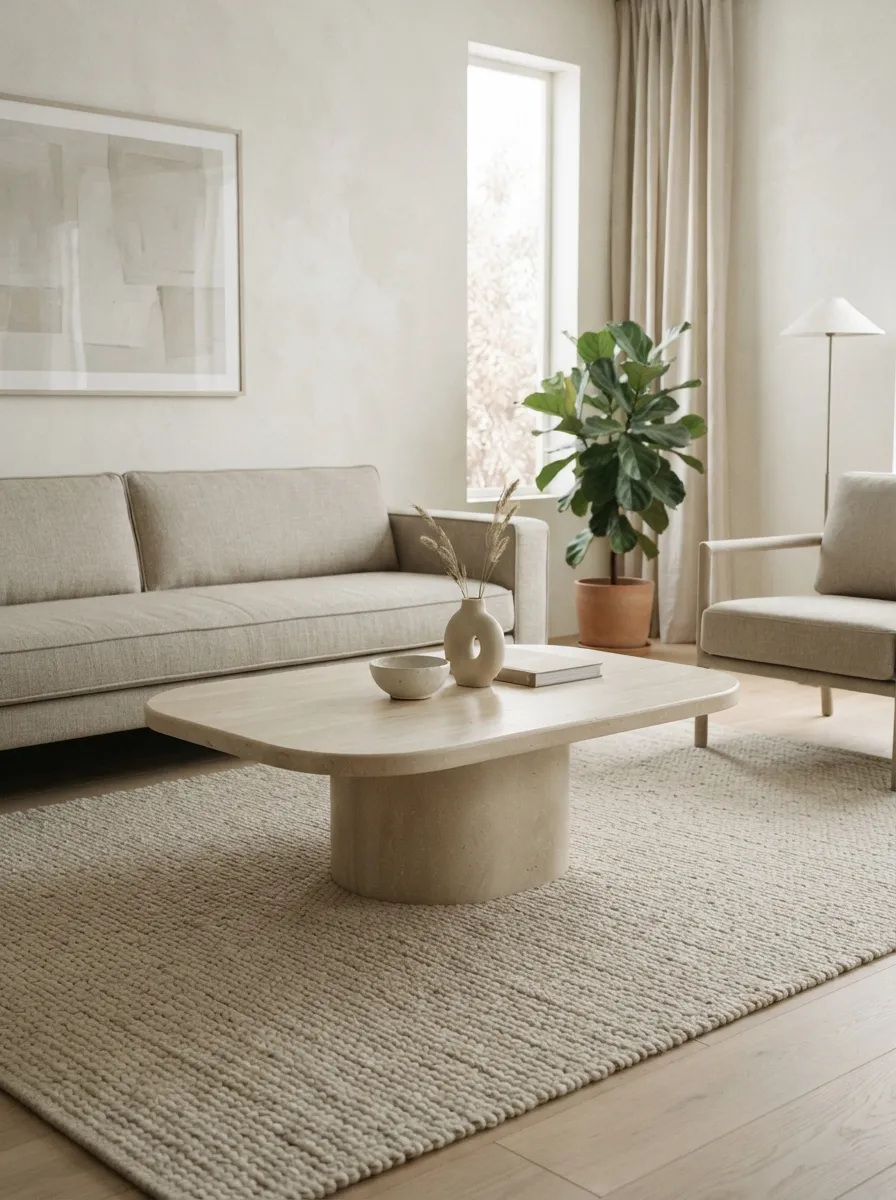
2. Let a pale stone-look table add mass without adding visual clutter
A pale architectural room can handle a table with more visual weight when the surface stays simple and styling remains restrained. The decision is less about naming a specific stone and more about how a broad, low table changes the center of the room.
The image shows exactly one low coffee table with a pale stone-like appearance and a rounded pedestal base. Soft daylight and a quiet architectural envelope keep the table readable without crowding it with decorative objects. The tonal variation is modest, so stone-look is the appropriate public description.
Do not treat the visual as proof of marble, travertine, concrete, a natural-stone slab, or any specific composite. Those material details need a real product listing.
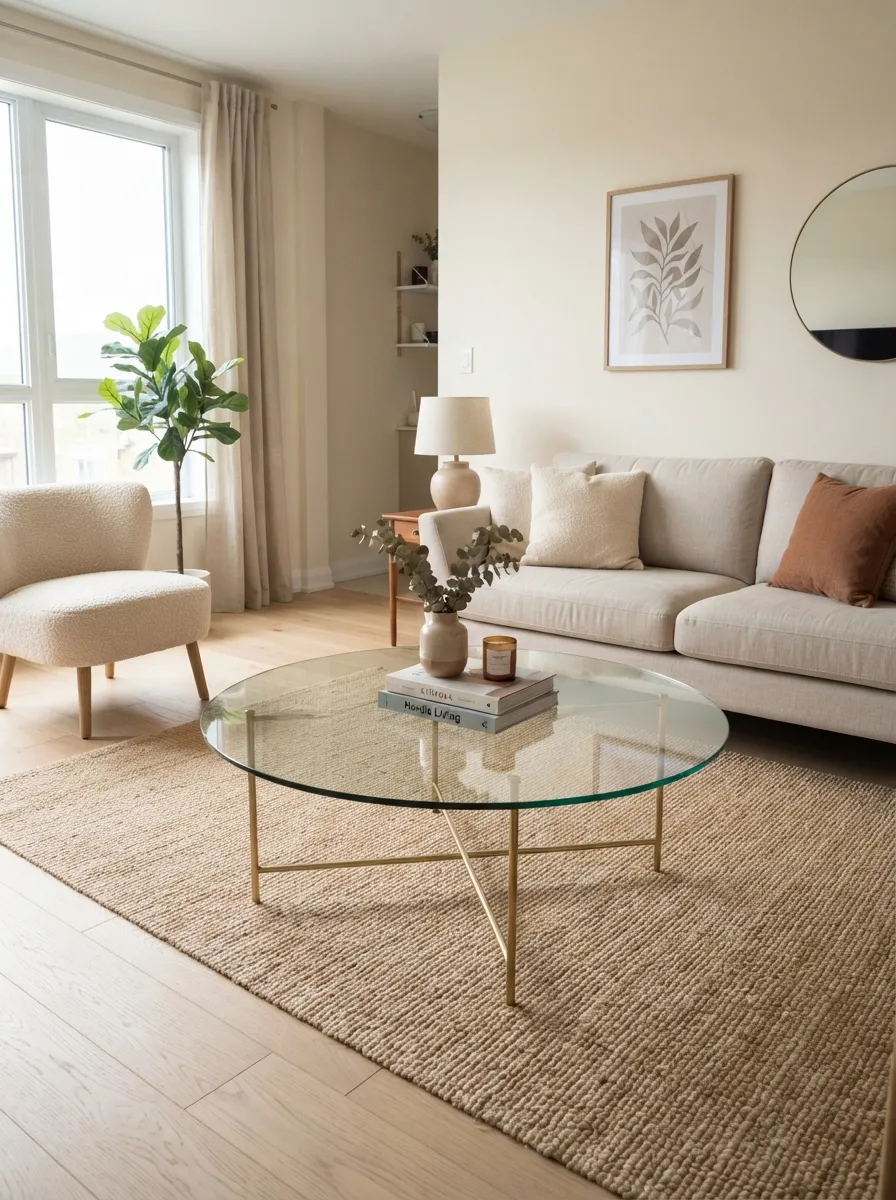
3. Use clear glass when you want the room to stay visually open
Transparency changes visual weight even when a table occupies real floor area. Crate & Barrel notes that glass can create a more open, airy effect, especially in smaller spaces, and Room & Board likewise describes glass-topped coffee tables as a way to make a room feel lighter or less cramped 1 4.
Exactly one clear glass coffee table appears in this compact living room. The transparent tabletop remains readable through its perimeter and edge highlights, while slim supports keep the structure visible without becoming visually heavy. Rug and floor can still be seen beneath and around the table, which makes the center of the room feel less blocked.
The image does not establish tempered-glass construction, glass thickness, edge treatment, safety certification, weight capacity, or impact resistance. Those are product specifications, not visual facts.
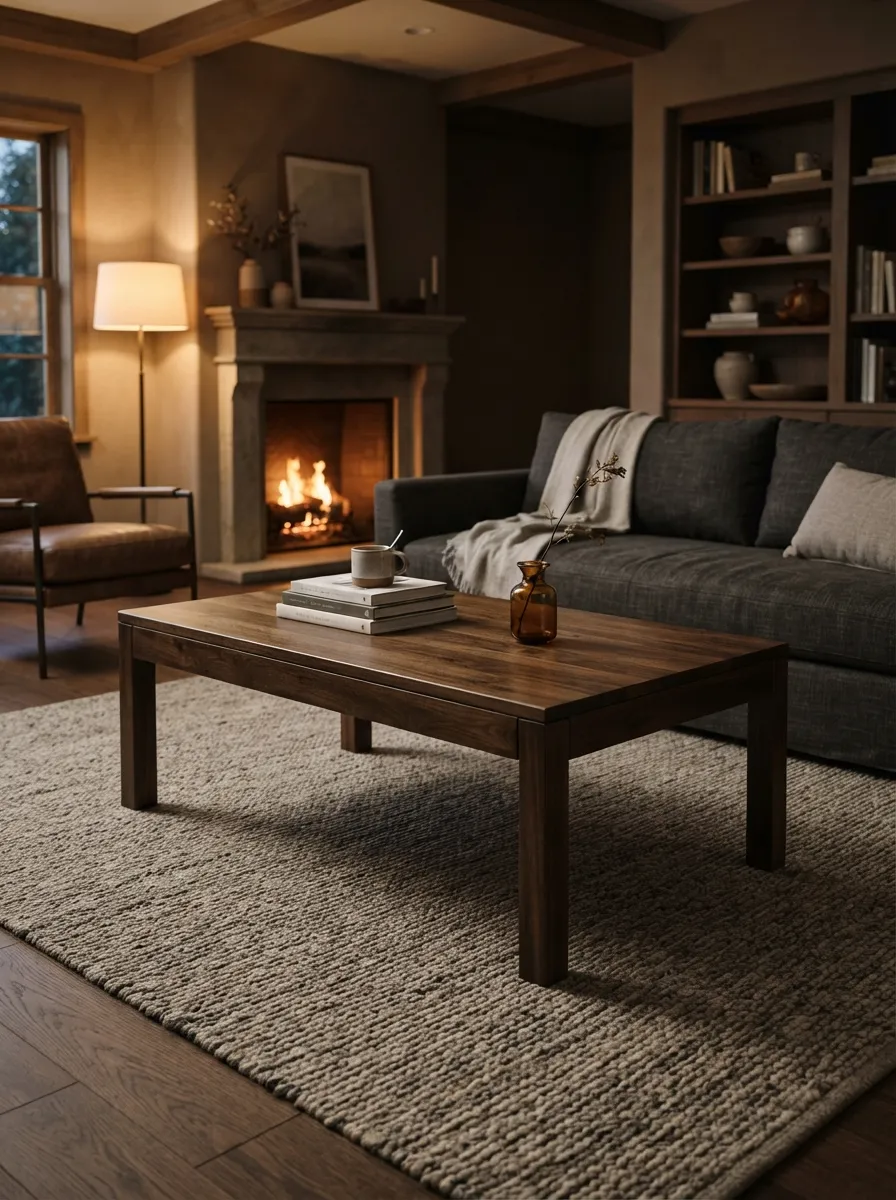
4. Ground a warm, moody room with a dark rectangular table
Rectangular coffee tables create a more directional center line than round forms. They can work especially well when the seating arrangement is long and linear; retailer guidance commonly pairs rectangular tables with longer sofas because the shapes echo one another 1 3.
Here, one dark wood-toned rectangular table remains completely readable, including all four corners, long and short edges, visible legs, and tonal variation across the surface. The surrounding fireplace, sofa, shelving, and warm ambient lighting stay secondary, allowing the table to act as a darker visual anchor rather than disappearing into the room.
Use dark wood-toned rather than walnut, oak, solid wood, veneer, or a named stain. The image cannot verify species, construction, or finish formulation.
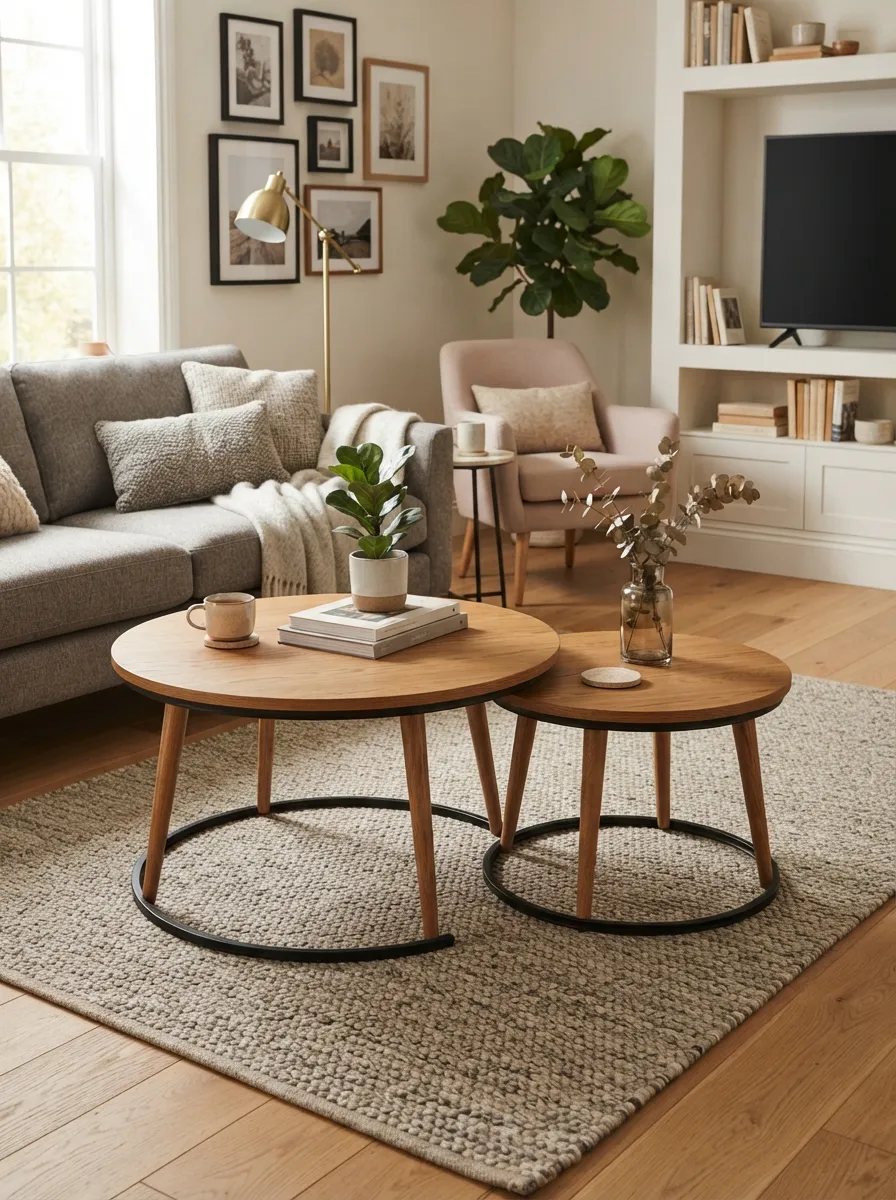
5. Use exactly two nesting tables when the center surface needs flexibility
Nesting tables are useful when you want more than one surface without permanently filling the entire center of the seating area. West Elm describes nesting coffee tables as pieces that can spread out for more usable surface and tuck together when floor space matters 3. That flexibility comes from the arrangement of separate tables; it should not be confused with a hidden mechanical system unless a product listing confirms one.
This scene contains exactly two coordinated nesting coffee tables: one larger table and one distinctly smaller companion. They overlap partially, but each keeps its own tabletop, edge, base, and silhouette. The smaller piece reads as part of the same coffee-table family, not as a stool, ottoman, or unrelated side table.
The image supports a flexible two-table arrangement, not a claim about hidden nesting hardware, tracks, locks, dimensions, or load capacity.
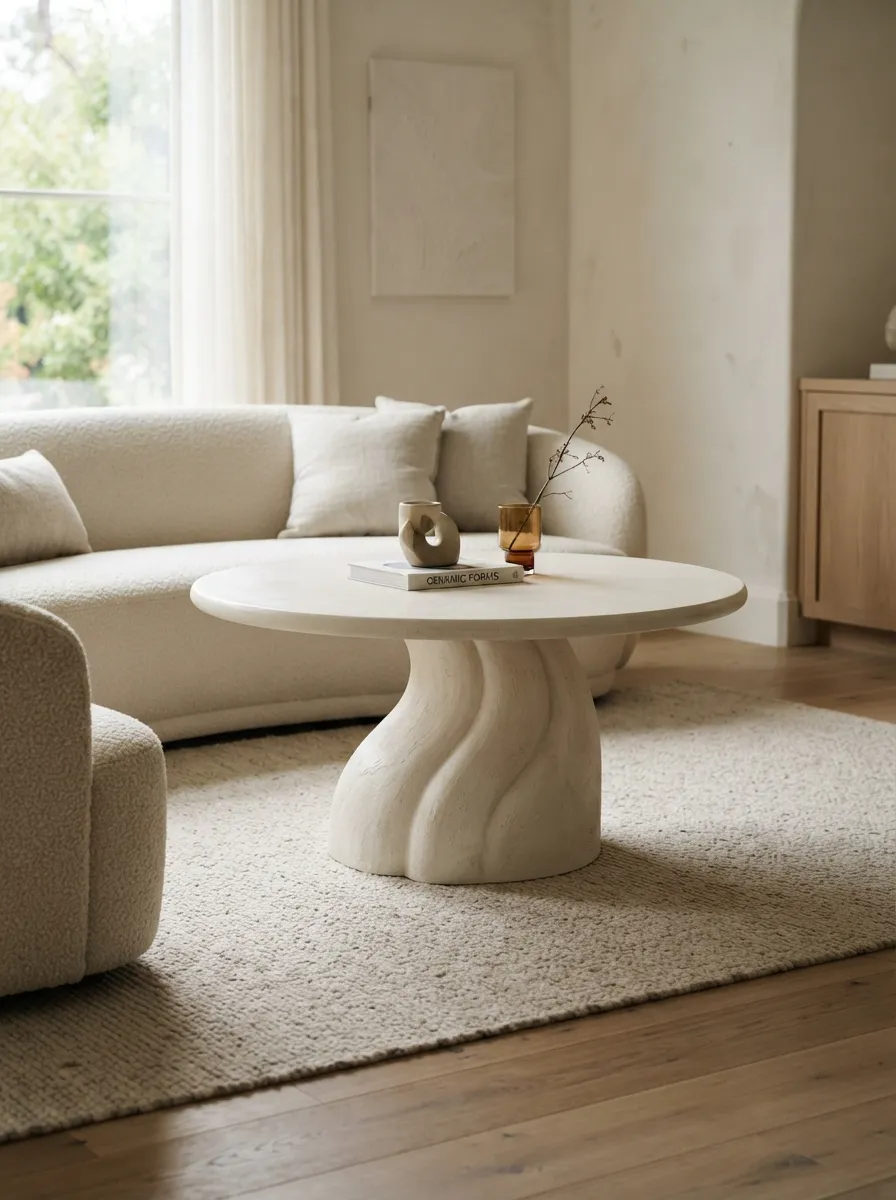
6. Make a sculptural pedestal table the focal point by reducing competition
A coffee table can function as the strongest furniture focal point when its silhouette is distinctive and the rest of the room gives it enough visual space. In that situation, adding more styling can weaken the effect; the table shape itself should do the work.
Exactly one sculptural pedestal coffee table is visible here. The full tabletop, strong edge profile, monolithic-looking base, and generous negative space make the silhouette easy to understand. Seating, cabinetry, rug, and decor remain subordinate, so the table does not drift visually into a side table, stool, dining table, or decorative plinth.
The photograph does not establish the exact material, fabrication method, weight, finish, or structural construction.
How to choose among these coffee table directions
Start with the room rather than the material name. A round table can soften a tight seating group; a pale stone-look form can add mass without darkening the room; clear glass can reduce visual obstruction; a dark rectangle can anchor a warm scheme; coordinated nesting tables can change how much surface is deployed; and a sculptural pedestal can become the main focal form.
Then verify the product itself. Measure the sofa, table, walk paths, and overall room rather than relying on a photograph. Use the 14–18 inch sofa-to-table guidance as a starting reference from established retailers, not as a guaranteed clearance for every body, sofa depth, or floor plan 1 2. Confirm exact dimensions, material composition, construction, glass specifications, weight, load capacity, finish, care, assembly, warranty, and availability with the current merchant or manufacturer.