Living Room
Modular Sectional vs. Stationary Sectional: Flexibility or a Settled Layout?
Compare modular and stationary sectional choices by reconfiguration needs, delivery access geometry, and visual continuity before buying.
Short answer: Choose a modular sectional when future room changes, moves, or rearranging are realistic possibilities. Choose a stationary sectional when the layout is settled and a single resolved silhouette matters more than reconfiguration.
That recommendation depends on product construction that must be verified from the listing, not guessed from a room image. The cited buying guidance distinguishes modular systems by their separate matching pieces and joining methods, while stationary sectionals are sold around a set configuration or orientation 1 2 3. The visuals below compare visible relationships—separate matching pieces, relative access geometry, readable unit boundaries, and continuous-looking silhouettes—without treating appearance as proof of hidden construction.
| Decision lens | Modular sectional | Stationary sectional |
|---|---|---|
| Future changes | Stronger fit when moving or rearranging is plausible | Stronger fit when the final room plan is settled |
| Access planning | Separate components may be easier to evaluate one piece at a time | A larger connected section can demand more continuous maneuvering space |
| Visual priority | Visible unit boundaries can be part of the look | A more continuous-looking settled silhouette may be preferred |
| Verify before buying | Module dimensions, connectors, compatibility, delivery, warranty | Orientation, dimensions, delivery method, construction, warranty |
1. Reconfiguration: separate matching units or one settled layout?
The first decision is how likely the room is to change. The cited guidance frames modular systems as useful when pieces may need to move, separate, or rejoin in a new configuration, while a stationary sectional better suits a room where the final footprint and orientation are already known 1 2 3.
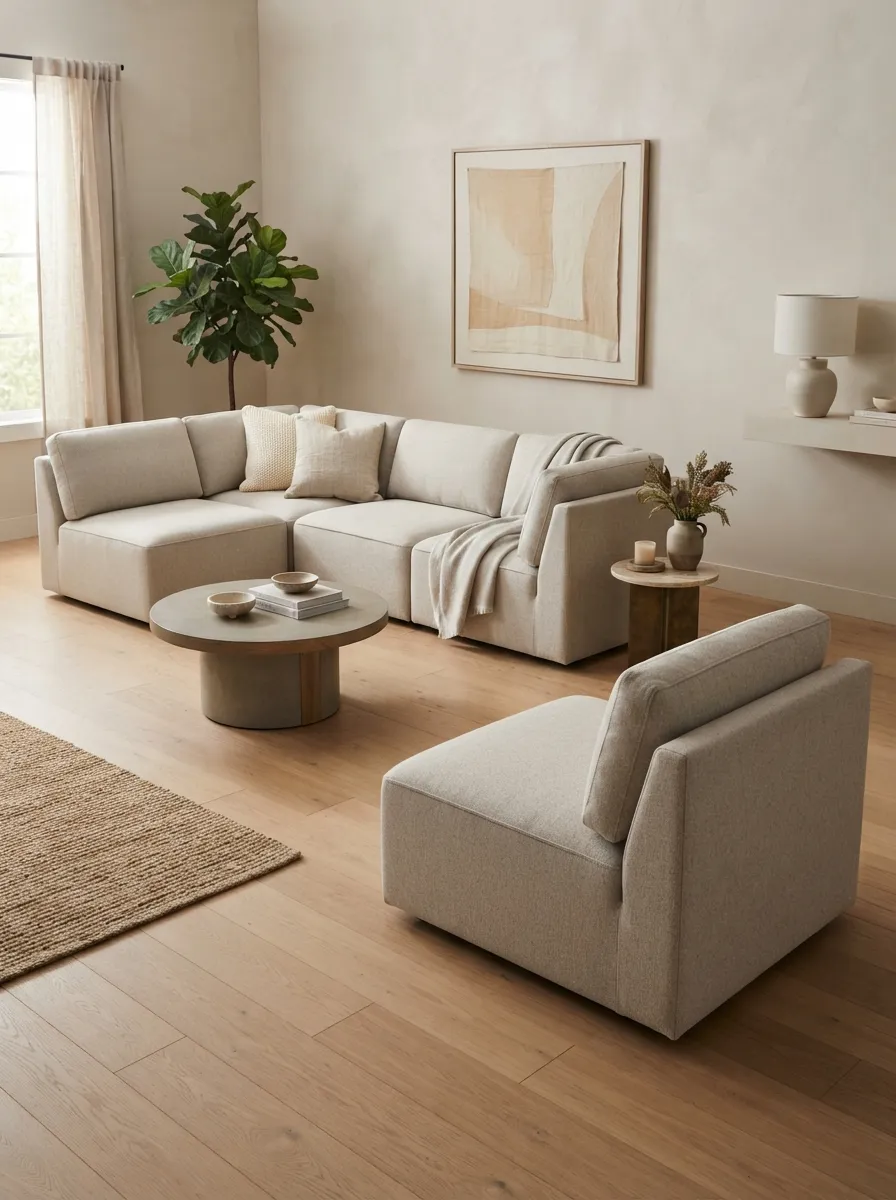
In the first visual, one main sofa-like grouping is paired with exactly one detached single-seat backrest-bearing unit. The detached piece matches the main grouping in upholstery tone, cushion language, and base proportions, while a strip of visible floor makes its independence obvious. The main grouping still shows multiple aligned seating units, so the scene communicates a family of matching pieces rather than an unrelated chair beside a sofa.
Caption: Matching seating units can visually separate into a different arrangement, with one detached backrest-bearing seat remaining clearly independent from the main grouping.
That appearance supports the idea of reconfiguration, but it does not prove manufacturer-approved modularity, interchangeable units, connector design, or compatibility between pieces. Those details belong to the current product listing and manufacturer documentation.
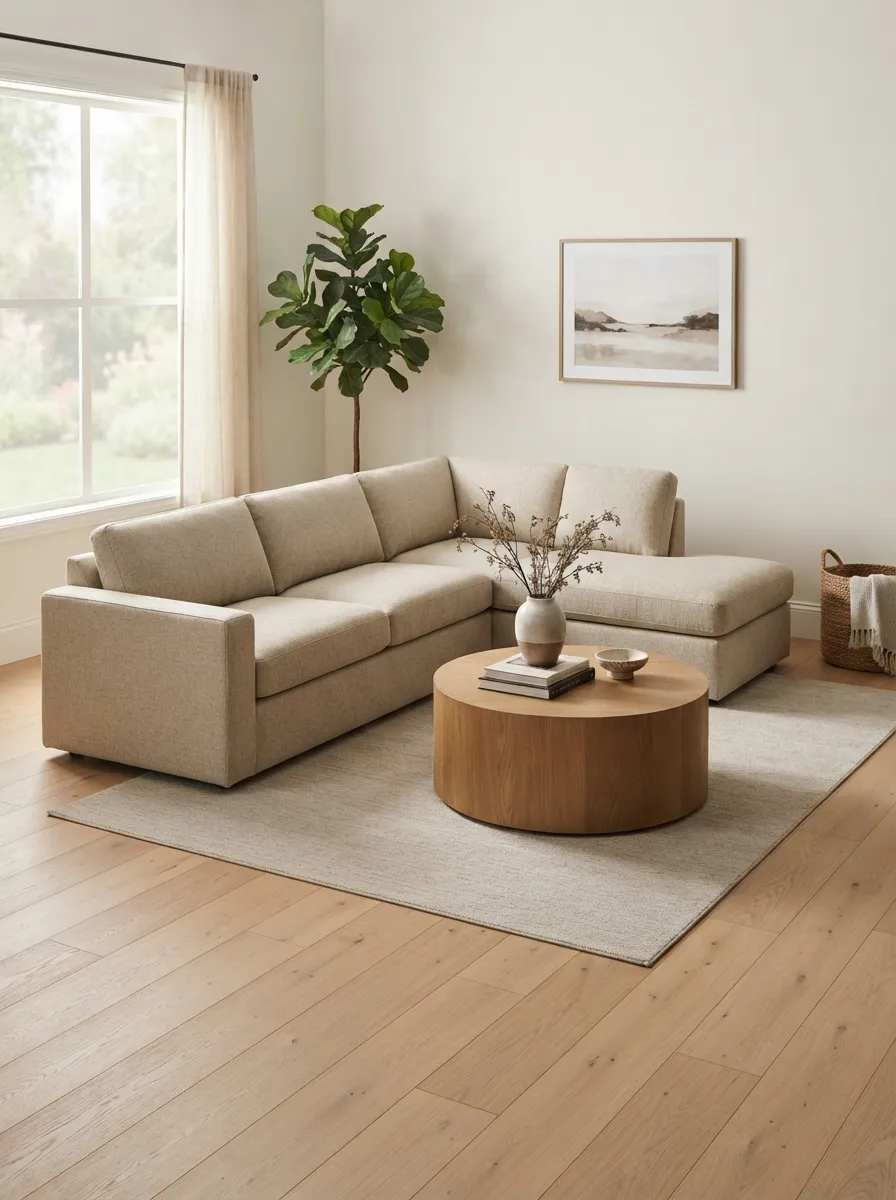
The comparison image presents exactly one L-shaped sectional as a settled connected furniture silhouette. Its return direction is fixed-looking, the corner connection is readable, and there is no detached matching component. Normal cushion divisions remain visible without making the body look scattered into independent blocks.
Caption: A settled L-shaped sectional reads as one connected seating zone with a single return direction and no detached matching piece.
The visual supports a resolved layout and continuous outer-body relationship only. It does not prove actual stationary-frame construction or the absence of hidden connectors.
2. Delivery and access: smaller separate components or one larger connected mass?
Delivery access should be checked before ordering. The source material recommends measuring doorways, stairs, landings, and other access points, then confirming product dimensions and delivery method with the seller 1 2 3. Smaller components can be easier to maneuver in some situations, but no image can guarantee doorway, stair, or elevator fit.
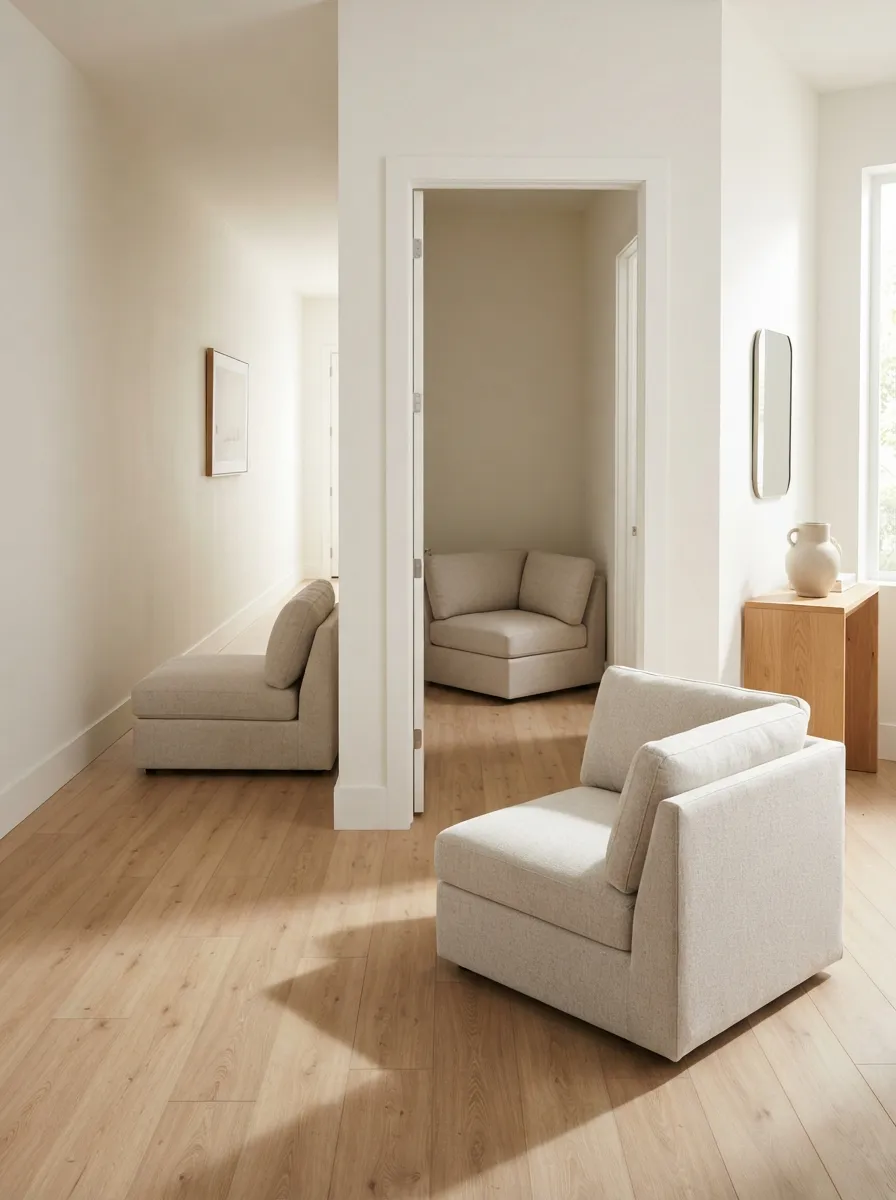
The modular-looking access scene shows three clearly separate matching components around a doorway and hallway turn. One backrest-bearing unit sits beyond or near the doorway, while two additional matching components remain separately staged. Visible floor gaps keep all three pieces distinct, and each component is visibly smaller than a complete sectional.
Caption: Three separate matching components make the doorway and turning geometry easier to inspect visually because each piece occupies a smaller independent footprint.
This scene illustrates relative access geometry only. It does not establish exact module dimensions, delivery method, actual modular construction, or guaranteed fit through any real doorway.
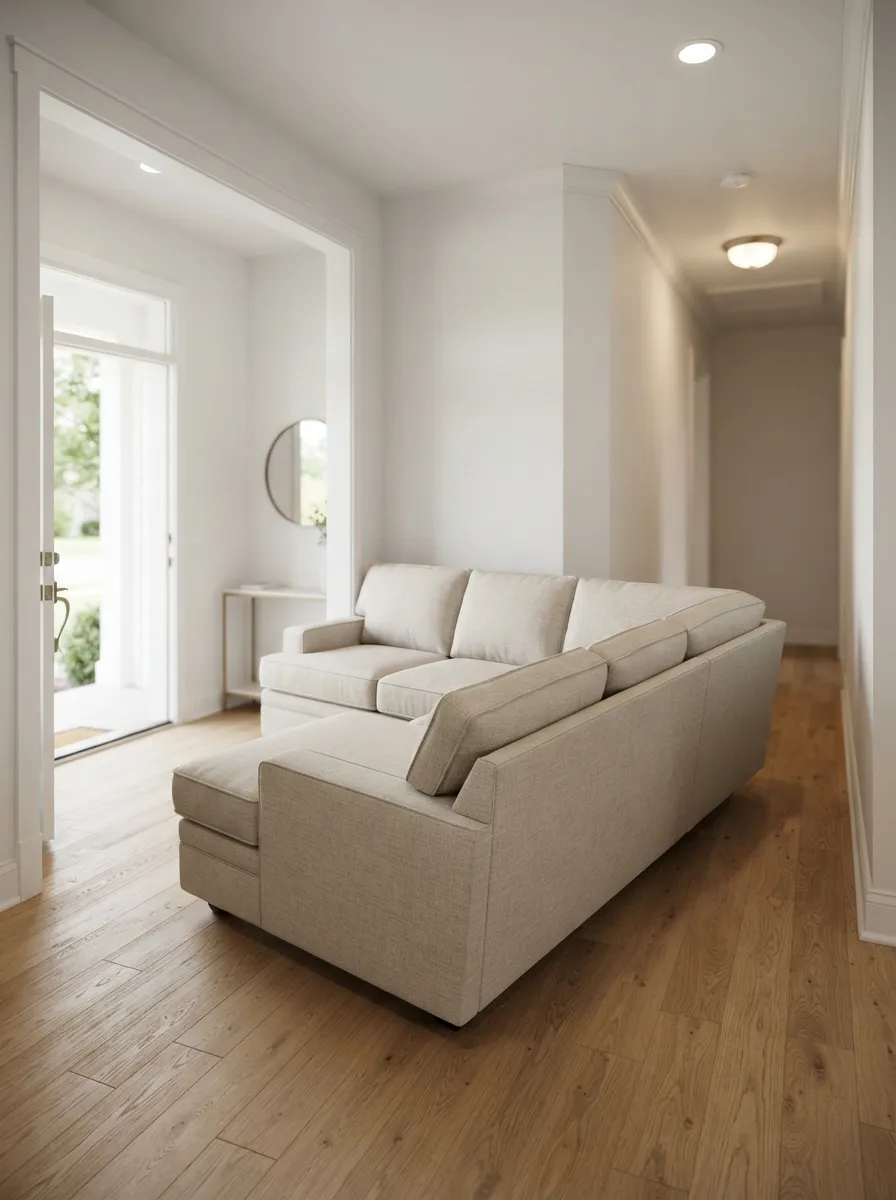
The paired comparison uses exactly one substantially larger connected light-neutral upholstered mass near a doorway and a perpendicular hallway relationship. The furniture remains physically plausible and grounded, but its continuous size makes the maneuvering commitment easier to see than in the three-piece example.
Caption: A larger connected upholstered mass requires more continuous maneuvering space around the same kind of doorway-and-hallway relationship.
The image does not show delivery failure, a permanently stuck sectional, or a precise clearance requirement. Use it to understand the geometry question, then verify actual width, depth, weight, disassembly options, doorway fit, stair fit, elevator fit, and in-home assembly with the current retailer or manufacturer 1 2 3.
3. Visual continuity: readable unit boundaries or a more continuous-looking silhouette?
The final decision is aesthetic but still tied to product structure. The source-backed comparison notes that modular systems may show repeated unit boundaries, while stationary designs can present a more unified outer silhouette 1. The visual evidence can show seams, repeated proportions, and continuity, but it cannot reveal hidden hardware or prove how the sectional was built.
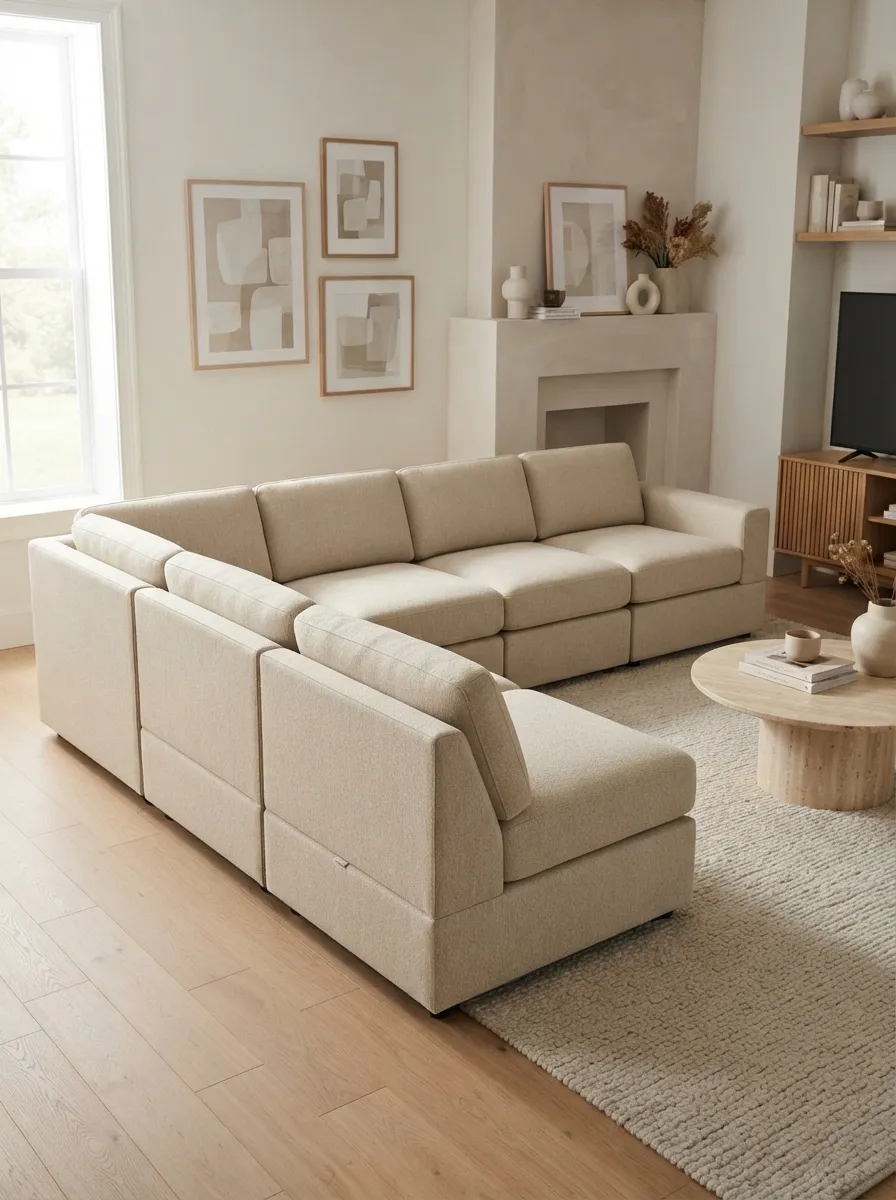
The first image shows exactly one connected L-shaped sectional with at least four readable matching seating units. Repeated seat proportions, aligned vertical seams, subtle base breaks, consistent cushion height, and a coherent corner make the unit rhythm visible without breaking the sectional into detached pieces.
Caption: The connected sectional reads as one seating system while repeated proportions, aligned seams, and subtle base breaks keep individual unit boundaries visible.
Those seams and breaks support a modular-looking appearance only. They do not prove connector type, actual modular hardware, or interchangeability.
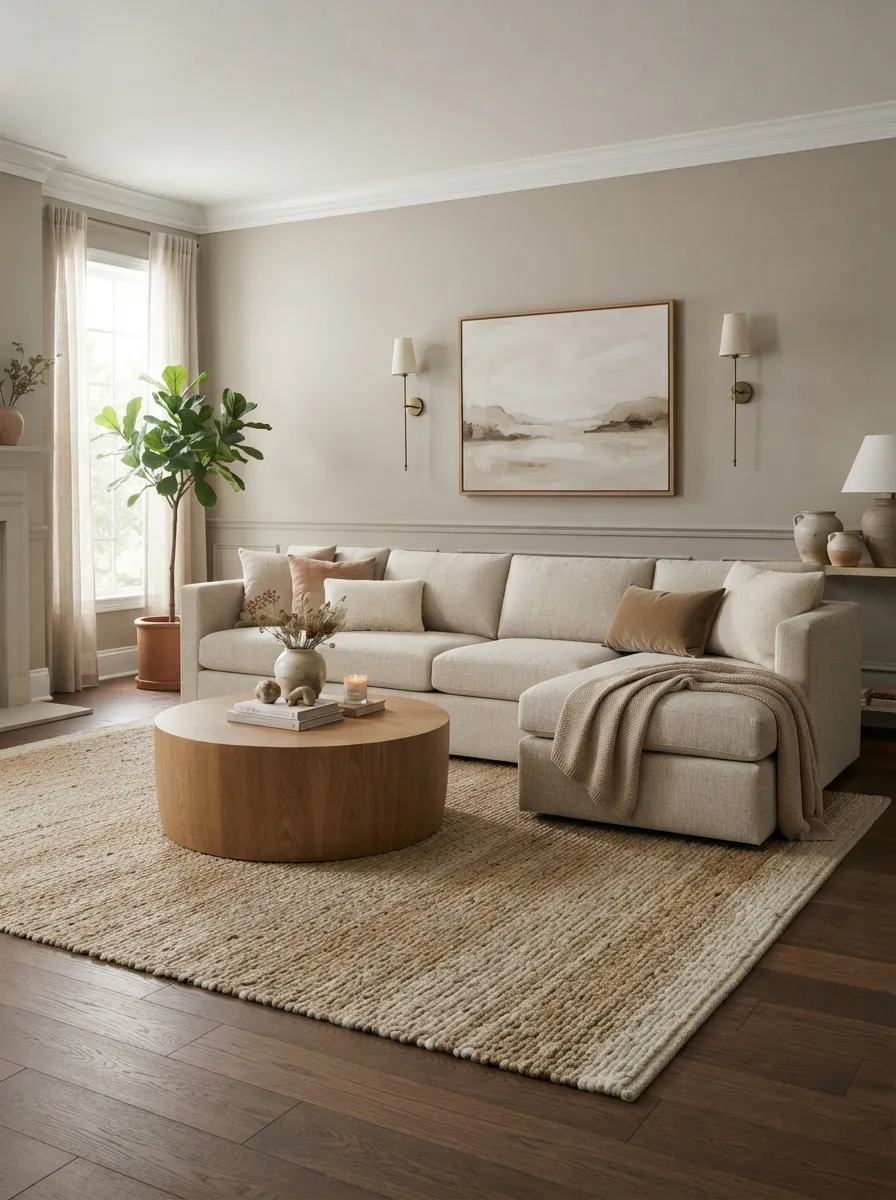
The second image shows one L-shaped sectional along a long wall with one settled chaise or return direction. Its lower body reads more continuously, and the back-and-arm relationship creates a unified outer silhouette. Realistic cushion seams remain visible, but there are no obvious detached units or strongly independent furniture blocks.
Caption: A continuous-looking outer body and one settled return direction create a more unified silhouette even though normal cushion seams remain visible.
A continuous-looking exterior does not prove one-piece construction, the absence of hidden connectors, or an internally stationary frame.
What to verify before buying
Use the three comparisons to decide which tradeoff matters most: future reconfiguration, access geometry, or visual continuity. Then move from visible cues to listing-level verification.
For a modular sectional, confirm actual module dimensions, arm and end options, connector or clip system, locking method, approved configurations, replacement-piece compatibility, warranty, and delivery method 1 2 3. For a stationary sectional, verify overall dimensions, left- or right-side orientation, chaise designation, whether the product ships assembled or in sections, in-home assembly requirements, warranty, and access needs 1 3. Reversible-chaise or semi-modular products sit between the two categories, so confirm the exact mechanism rather than assuming the chaise or end units can switch sides.
Exact seat depth, weight, upholstery composition, comfort, durability, assembly, stair or elevator fit, replacement-part availability, and current product availability all require current merchant or manufacturer information.
Final decision
Choose modular when the household, room, or address may change and separate matching units are genuinely useful. Choose stationary when the layout is settled and you prefer one resolved seating silhouette. The visuals can clarify visible tradeoffs, but actual construction, connection system, delivery feasibility, and configuration options must be verified before purchase.